Striving
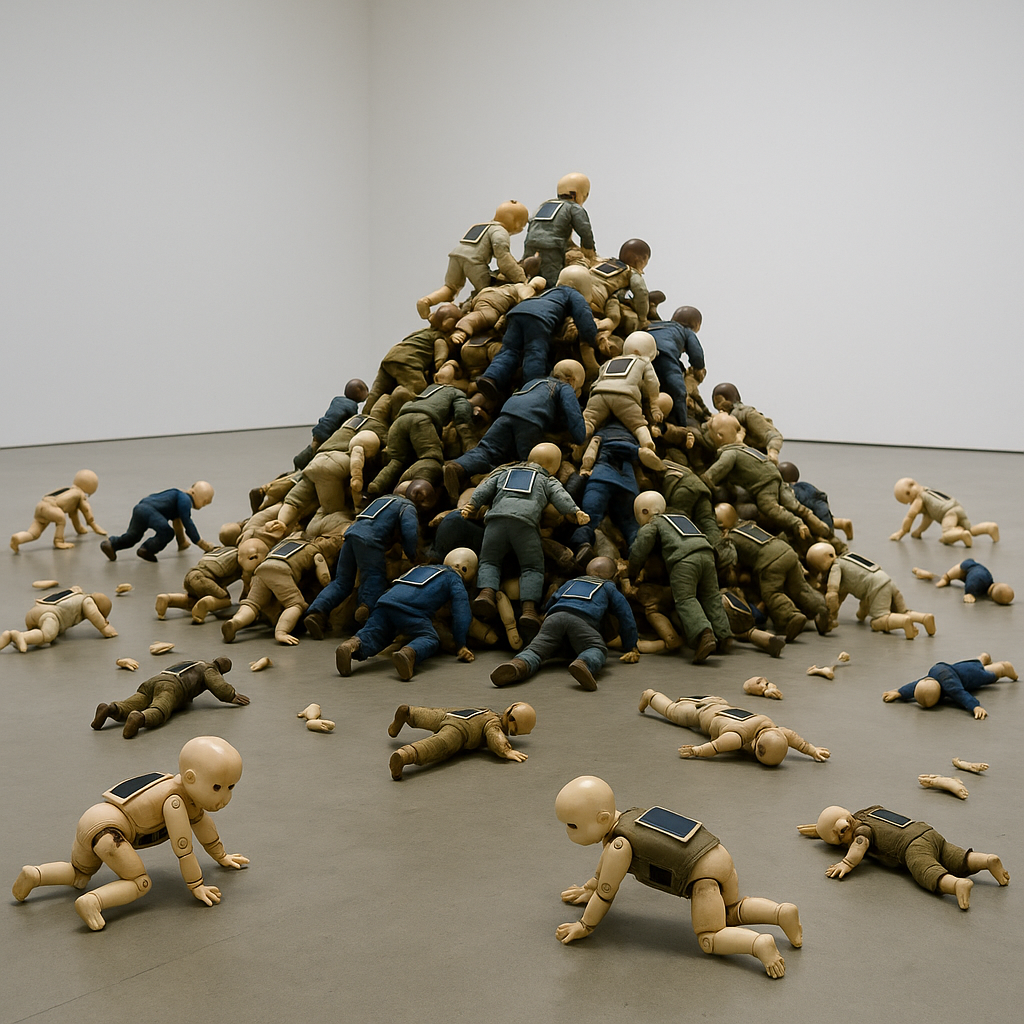
A dense mass of thousands of miniature human figures, each engineered to climb using internal micro gear motors and powered only by tiny on-board photovoltaic cells, forms a six-foot-tall mound in the gallery. Left alone, the figures collapse into a conical pile shaped by gravity, friction, and their natural angle of repose, behaving like a granular material that settles without choreography. When light reaches the exposed surfaces, sunlight drifting through windows, fixed gallery spots, or visitor-controlled high-powered lamp, the outer layer of toys activates and begins to climb upward, scrambling over and across the shifting terrain of other bodies. Zones of motion pulse through the mound wherever light lands, so the overall form is never fixed, continuously reshaping itself as climbers rise and fall. The installation becomes a physical game about who gets access to energy and elevation, and what kind of collective structure emerges from thousands of simple, light-hungry lives.
Detailed Description
Striving is built around a simple, dense mound of small climbing figures occupying a roughly six-foot by six-foot footprint and rising to about six feet tall. Each figure is a minimalist, vaguely human form—torso, limbs, and a small "backpack" of solar cells—mounted on tiny gear motors and feet designed to grip, slip, and catch against other bodies. When they are unpowered, the figures behave like granular material: they tumble and settle into a conical pile shaped by gravity, friction, and their shared angle of repose.
The only energy source for the figures is light. Embedded in the gallery ceiling and walls are controllable spotlights and a small number of high-powered flashlights. Natural light from windows, when available, also plays a role. When light reaches the exposed surfaces of the mound, the figures in that illuminated skin begin to wake: motors engage, and they attempt to climb upward against the slope, stepping over and across the figures beneath them. Those lower down remain inert until they are exposed, either because the mound shifts or because someone moves a beam.
Visitors interact with the piece almost entirely by shaping the light. They can:
Adjust the aim and spread of a few flashlights.
Gently reposition figures, either helping them to more favorable positions or pushing them into shadow.
All motion emerges from the combination of light, gravity, and each figure’s simple climbing behavior. When a group collectively focuses light on one area, that zone erupts into activity: figures scramble upward, dislodging others, triggering small avalanches of bodies. When light drifts away, motion slows, and the mound gradually settles into a new configuration.
Over hours and days, these local disturbances accumulate into larger changes. A bulge develops on one side where figures repeatedly succeed in climbing; a hollow forms where they repeatedly slide away; small "ridges" of stable bodies appear where motion and friction balance out. The sculpture never fully resets. Even if the lights are dimmed or turned off at closing, the final shape of the mound carries the imprint of countless past decisions about where to shine energy and how roughly to handle the climbers.
Conceptual Frame (Play & Tensions)
Striving begins from a simple physical fact: most life on this planet is ultimately an extension of sunlight. Plants capture it, ecosystems route it, and over time the crazy complexity of bodies and behaviors we call "nature" emerges as one long, indirect expression of light. The mound distills that chain into a blunt mechanism. Each tiny figure is a crude lifeform whose only drive is to climb when illuminated. The question hovers over the piece: are these chattering, light-hungry toys really so different from us, or are we just a more elaborate way for sunlight to move matter uphill for a while?
Light here stands in for both biology and power. It is a basic ingredient for motion, but also a scarce, steerable resource. The mound makes visible how such resources are never evenly distributed. A narrow beam of illumination can create a tiny elite of active climbers while thousands remain buried and inert. When visitors broaden the light, activity spreads but intensity drops; when they focus it, a small group surges upward while others slide back. The piece frames these choices as play, but the underlying dynamics echo familiar structures of privilege and neglect.
Because the climbers are small, nearly identical machines with no interior psychology, any sense of triumph or despair is projected by the viewer. People quickly develop favorites or feel sorry for figures that repeatedly fall just short of the crest, even though all are following the same blind rules. The mound becomes a surface for narrative: we explain what is happening in moral or personal terms even when the mechanics are brutally simple.
Allowing limited physical contact with the edges of the pile, nudging a figure into the light or burying it a little, adds another layer. Visitors are not only shaping abstract flows of energy; they are also literally handling bodies, deciding which ones to help, which ones to ignore, and which ones to sacrifice to keep others moving. The piece nudges people to notice how quickly casual gestures can turn into structural bias when repeated at scale.
By placing the lamps in visitors’ hands, Striving quietly hands them a god-like role. For once, they control the sun. They can bless one region of the mound with abundance and plunge another into scarcity, or they can attempt a fragile, imperfect fairness. By keeping the wiring, solar cells, and mechanical details visible, the work resists the comforting myth that upward movement is purely the result of effort or virtue. It foregrounds the systems, light placement, surface friction, the geometry of the heap, that determine who gets to climb. The result is a quietly unsettling kind of fun: you are rearranging toys in a beam of light, but also rehearsing how easily we accept uneven outcomes when they are framed as the natural behavior of a pile.
Structure of Participation
Type of space: Self-directed installation organized around a central mound on the floor, with adjustable light stands and clear paths around its perimeter.
Rules: Brief signage explains the basics: the figures only move in light; you may adjust designated lamps and gently move climbers at the edge of the mound within marked zones. There are no scores, timers, or fixed goals.
Guidance: Light staff presence to prevent people from climbing onto the mound or handling figures too aggressively, and to manage how many visitors adjust lights at once. No performers are required.
Intervals: The piece runs continuously, with optional dimming periods or manual redistributions during maintenance to keep the system mechanically healthy without erasing its history.
Social Dynamics
Visitors naturally cluster at the light controls and the edges of the mound. Some will try to "help" as many figures as possible by spreading light broadly; others will concentrate beams to push a small region of the pile toward a visible crest. Informal alliances and small conflicts emerge as people compete for control of the lamps or argue over whether to rescue buried climbers or let them slide.
Onlookers who aren’t touching the lights still participate by pointing out patterns, where the pile is thinning, which side always seems to win, which figures keep almost making it. Over time, groups may invent their own mini-games: racing to create a new ridge, ignoring one quadrant entirely, or seeing how quickly they can overturn the current configuration.
Attention stays on the slow, collective movement of the mound and the physical sensation of aiming beams and shifting small bodies. The container is simple, light, and gravity acts on a pile, but the ethical and emotional readings are open-ended: Is this fair? Is it inevitable? What does it feel like to be the one holding the lamp?
Requirements & Support
Run time: Engineered for a continuous 4+ month run, with durable figures, robust motors, and reliable solar cells. Regular maintenance is required for cleaning dust, checking mechanical wear, and redistributing or repairing jammed climbers.
Space: Approximately 300–1000 sq ft within the larger allocation, including the mound, a safety perimeter, and room for light stands and visitors to circulate.
Staff & expertise: Mechanical/electrical engineer for figure design and power systems; interaction/lighting designer for lamp layout and controls. Daily operation by gallery technicians trained to manage visitor interaction, perform minor repairs, and implement maintenance protocols.
Saleable elements: Individual climbing figures or groups. Time-lapse video works can be editioned.