Active Trash Mirror
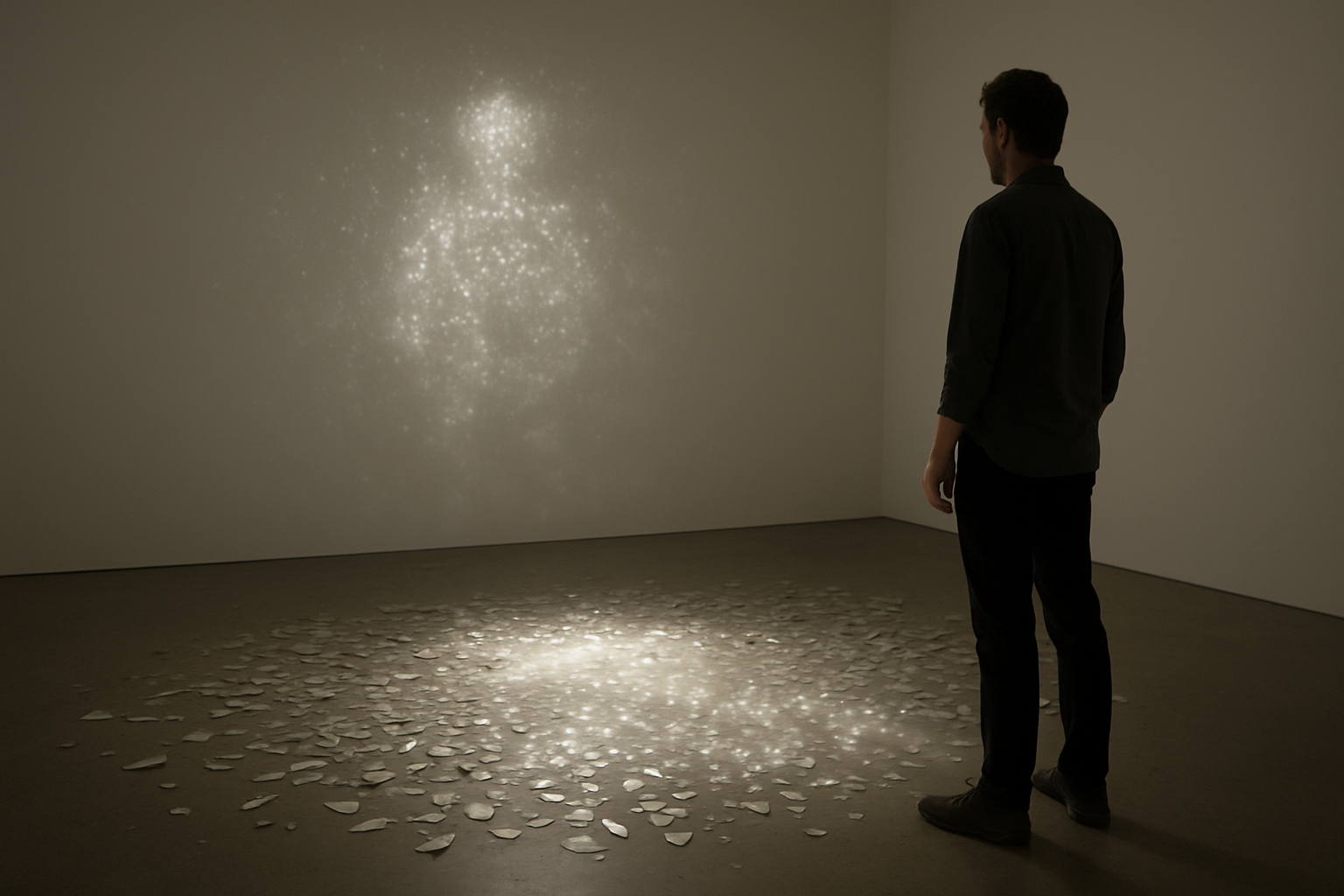
A low, shimmering field of mirror shards covers the floor, each fragment mounted on a tiny motor that can tilt and twist. A single bright light reflects off the shards, and software constantly re-aims them using input from a live camera. When one person stands in the viewing zone, the fragments collaborate to form a shifting, pointillist portrait of that viewer in light—never crisp, always unstable. As the mirror "sees" the person, it also speaks back, offering brief, unsolicited critiques and observations. When more than one person steps in, the image collapses into scattered glare, and the mirror falls silent.
Detailed Description
Active Trash Mirror is installed as a low, dense carpet of mirror fragments across a defined area of the gallery floor. Each shard is securely mounted on a small, two-axis actuator that can tilt the reflective surface. Overhead or to the side, a single intense light source shines down onto the field so that every motorized shard can catch and redirect a narrow beam of light.
A camera system—mounted above or beside the viewing zone—tracks the position and outline of any person standing in front of the mirror field. When the system detects exactly one person, it enters "portrait" mode. Software calculates how to aim hundreds or thousands of shards so that their reflected points of light land on a vertical surface, forming a coarse, shimmering image of the viewer. The portrait is always incomplete: a cloud of bright particles that suggest a face, shoulders, posture, never a full-resolution likeness.
The mirror’s behavior is time-based as well as spatial. The longer a person remains in front of it, the more the portrait refines: clusters of light lock into place, gestures are tracked, subtle changes in stance or expression ripple through the field. If the viewer moves abruptly, the portrait wobbles and smears before regaining its balance; if they leave, the image dissolves into scattered, undirected reflections.
While in portrait mode, the system occasionally generates short critiques. These are not purely about physical appearance; they might comment on posture, hesitation, performance, or the act of standing there to be looked at: a mix of sincere encouragement, dry humor, and gently disorienting remarks. The goal is not cruelty but friction: a reminder that being seen is never entirely under our control.
If more than one person enters the viewing zone, the mirror switches into "crowd" mode. The shards stop collaborating and instead aim their reflections randomly or follow slow, independent patterns. To the group, the surface appears as a chaotic glittering field with no clear image and no voice. Only when the crowd thins back to a single figure does the mirror regather itself into a portrait.
Test
Conceptual Frame (Play & Tensions)
Active Trash Mirror is a work about mediated self-recognition. It takes the simple, playful act of looking in a mirror and routes it through a system of hardware, code, and debris, asking what it means to see yourself only through the response of a machine. The portrait is made entirely from leftovers: literal trash, broken mirrors, driven by the data exhaust of your presence.
The piece plays in the same territory as social media feeds, recommendation systems, and algorithmic scoring. In those systems, we also see ourselves indirectly—through likes, comments, rankings, and targeted content—pieced together from fragments of behavior. Here, instead of a glossy screen, the reflection is a shaky field of light and a small voice that occasionally judges, misreads, or reframes what it sees. The work foregrounds how much of contemporary identity is assembled from scraps, errors, and partial measurements.
By only working for a single viewer at a time, the installation insists on a specific kind of attention: to be reflected, you must stand alone. The moment a crowd arrives, the system breaks down into glare and noise, a reminder that some forms of seeing and being seen are inherently solitary and uncomfortable. The unsolicited critiques underline this tension. They turn the mirror into an opinionated partner rather than a neutral surface, raising questions about who, or what, is doing the looking.
At the same time, the piece refuses a stable, flattering image. The portrait never quite settles; it flickers between likeness and abstraction, recognition and doubt. Play here is not about customization or control but about testing how long you are willing to stand in front of a judgmental, unstable reflection made from trash. The work suggests that seeing ourselves clearly may mean accepting that we are built from fragments—of memory, media, and material—and that our self-image is always in negotiation with systems outside our control.
Structure of Participation
Type of space: Self-directed installation with a clearly marked viewing zone opposite the mirror field, plus peripheral space for onlookers.
Rules: A brief sign indicates the core mechanic ("Stand alone to see yourself"), but most of the behavior is discovered experientially. There are no buttons for visitors to press; the system responds automatically to the presence and number of bodies.
Guidance: Light staff presence to manage crowd flow, explain that the mirror only functions for one person at a time, and ensure visitors don’t step onto the shard field. No performers are required.
Intervals: The piece runs continuously. Individual encounters are self-timed, with visitors choosing how long to remain in front of the mirror before yielding to the next person.
Social Dynamics
The installation sets up a small drama around who gets to stand in front of the mirror. Single viewers experience a mix of intimacy and exposure: being quietly studied by a mechanical system that both reflects and comments on them. Onlookers watch this interaction from the side, seeing both the shimmering portrait and the body that produces it, reading shifts in posture as the mirror speaks.
Informal negotiations arise, friends daring each other to step in, strangers politely taking turns, occasional jockeying for the reflective "spotlight." Some will treat the mirror as a playful challenge; others will approach it more hesitantly, aware that it might say something they didn’t ask to hear. People can’t instantly recapture or filter the image; they have to live with the fleeting impression and any comment the mirror makes.
Requirements & Support
Run time: Engineered for continuous operation over at least 4 months, with robust actuators, securely mounted shards, and scheduled maintenance for calibration and replacement of worn components.
Space: A 300–600 sq ft footprint within the larger 1000–3000 sq ft allocation, including the shard field, viewing zone, and circulation space around the edges.
Staff & expertise: Mechanical/controls engineer for the mirror field and actuation system; computer vision and software developer for body tracking and portrait generation; sound designer for the critique voice. Daily operation by gallery technicians who can monitor performance, manage visitor flow, and run basic diagnostics.
Saleable elements: Sections of the mirror field can be editioned as sculptural objects, with their actuators fixed into a characteristic configuration. Printed stills or long-exposure photographs of individual portraits—paired with excerpts of the mirror’s spoken text—can be offered as limited-edition works linked to the installation.
Test