Self Assembly
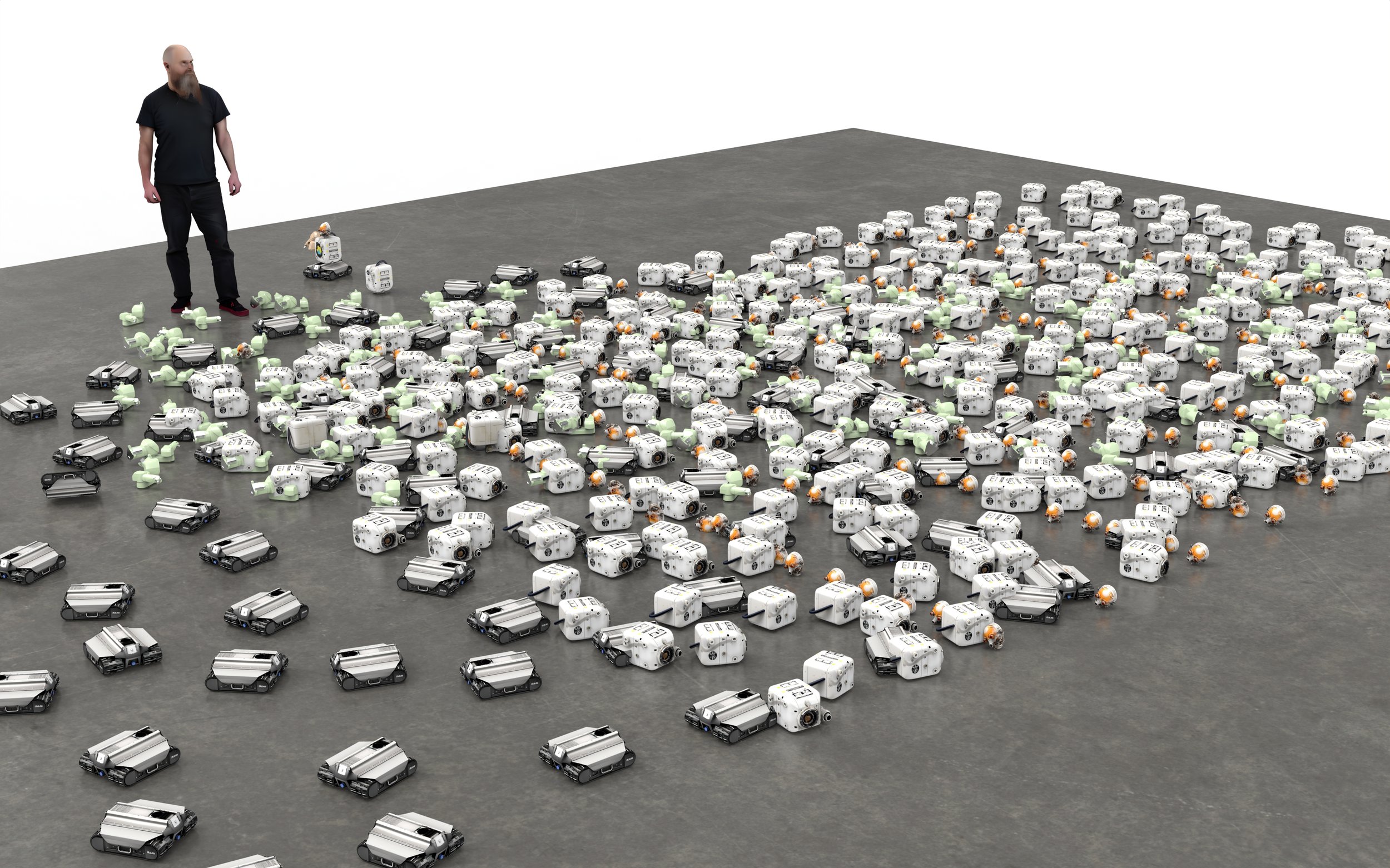
A field of robotic body parts is scattered across the gallery floor like industrial debris. Viewers are invited to assemble a working robot from the shared pool of parts at a simple "maker" station. When a robot first powers up, it takes a picture of its maker and generates a graphic crest that appears on an LED screen on its back. That robot then enters the field and begins making copies of itself from the parts around it, giving each of its children the same crest. As more machines come online, multiple lineages grow, compete for resources, and eventually start raiding each other’s bodies. Visitors watch this self-organizing system evolve and intervene through a “god panel” that can change the rules or trigger catastrophic events. The piece reads as a live strategy game about growth, identity, scarcity, and the blunt force of top-down control.
Detailed Description
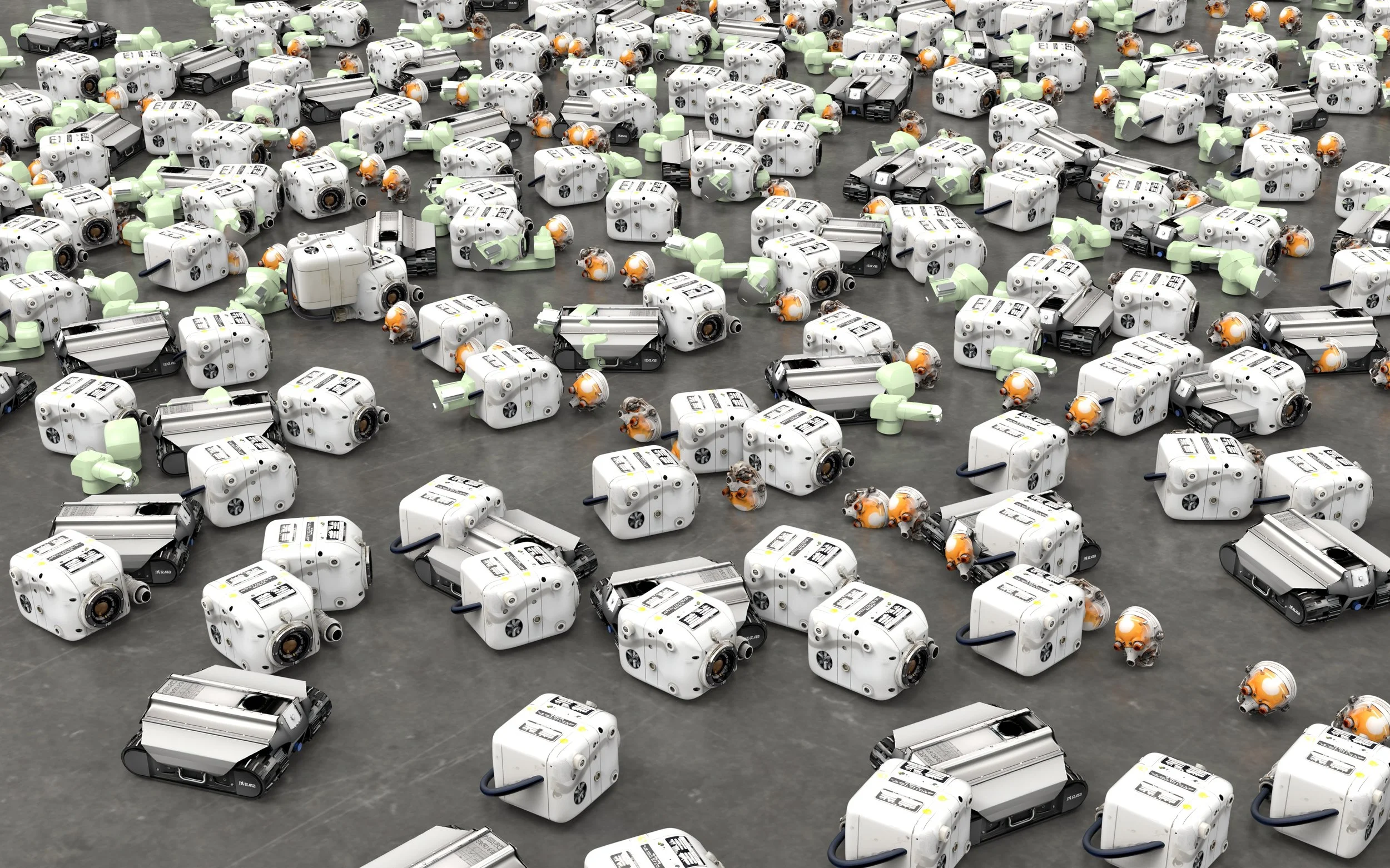
Spread across the gallery floor is a low field of modular parts: identical torsos, mobility units, arms, and heads. From a distance, it reads like debris or an incomplete product run scattered across an industrial floor.
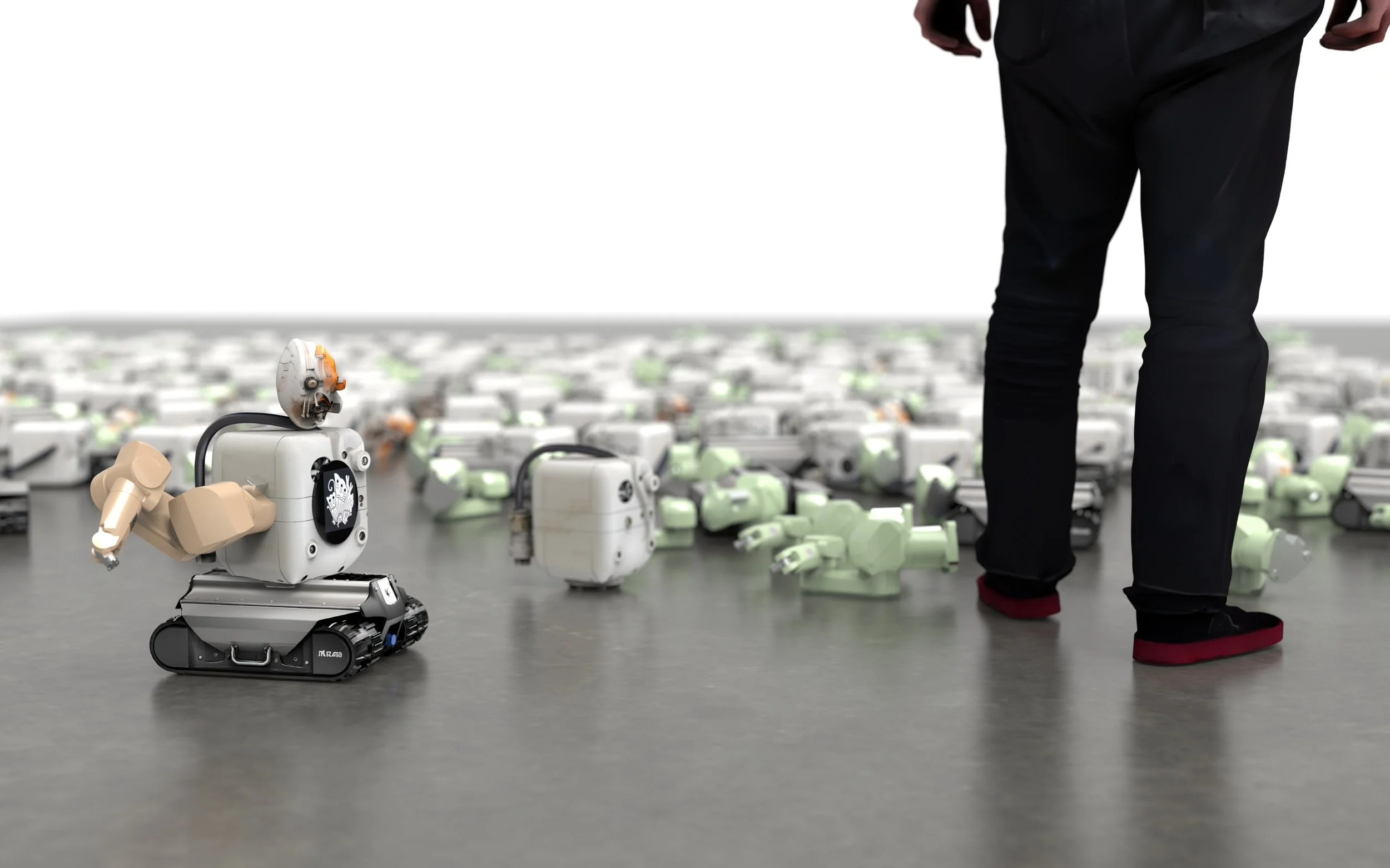
At one edge of the space is a simple assembly station. Here, a visitor is invited to snap together a basic robot body from the parts at hand. Each completed robot is a compact, purpose-built machine: a torso with battery and controller, a single manipulator arm, a head with a small camera, and a tracked or wheeled base.
When a visitor powers up their robot for the first time, the robot turns toward them, captures an image, and generates a stylized crest or icon from that picture. This crest appears on an LED panel on the robot’s back and is tagged to that robot’s entire lineage.
The robot then leaves the station and enters the field, scanning the floor for compatible modules, snapping them together with magnetic joints, and waking new robots into action. Each new robot inherits the crest of its progenitor, forming a visible "family" moving through the space.
As more visitors build founders, multiple lineages begin to coexist: two, four, eight, sixteen. They all draw from the same finite pool of parts. Over time, assembly logic shifts from easy growth to competition. Robots begin to disassemble abandoned or stalled bodies for parts; some may pull limbs from fully functioning robots of another lineage. The self-assembling field tips from growth into scavenging, and then into a slow, mechanical conflict over limited bodies.
A "god panel" sits off to one side for the viewer. From here, visitors can intervene in the system with coarse, planetary-scale actions: altering rules of behavior, biasing particular lineages, freezing or accelerating reproduction rates, or triggering a "flood" event that sweeps robots and parts to one side of the gallery, forcing the system to reconfigure. The piece becomes a live simulation of self-organization, resource competition, inherited identity, and top-down catastrophe—all enacted by small, pragmatic machines on the same floor as the viewer.
Conceptual Frame (Play & Tensions)
Self Assembly treats play as a real-time strategy game about legacy. A single casual act—building a robot and letting it take your picture—spawns an entire lineage that carries your image through the system. The work stages the tension between bottom-up emergence (robots following simple rules) and top-down control (the god panel rewriting those rules mid-game). It also examines how quickly cooperation over shared resources can slide into quiet predation, with lineages cannibalizing each other’s bodies while still carrying the faces of their makers.
Structure of Participation
Type of space: Self-directed interactive room organized around three zones: the assembly station, the active robot field, and the god panel.
Rules: Core rules are discovered through observation and trial and error. The assembly station and god panel use minimal icon-based labels (build, start, bias, flood) rather than text-heavy instructions.
Guidance: Light staff presence to handle safety, occasional resets, and basic guidance at the assembly station; no performers are required. Physical intervention by the audience is allowed.
Intervals: Designed for timed groups, but the system runs continuously. New visitors arrive to find an existing ecosystem of lineages and can choose to add a new founder, adopt an existing lineage, or experiment with the god panel.
Social Dynamics
The piece encourages visitors to adopt a role: builder, observer, or "god." Builders can focus on their own robot and its crest, then track how their lineage fares in the field. Observers gather at the perimeter, reading the crests and speculating on which line belongs to whom, who is thriving, and why. The god panel invites soft conflict and negotiation: some visitors try to protect their own lineage, others sabotage successful families, and others experiment just to see what happens. The container is made legible by the physical layout—the clear assembly zone, the battlefield of parts, the visible crests on robot backs, and the isolated control console.
Requirements & Support
Run time: Engineered for continuous operation over at least 4 months with scheduled maintenance windows and the ability to pause and resume the simulation without losing lineage data.
Space: Ideally, a 1000–2000 sq ft footprint within the larger 1000–3000 sq ft allocation, with a clear boundary between the assembly area, the robot field, and the god panel.
Staff & expertise: Robotics/controls engineer, mechanical fabricator, and software/vision developer for creation; daily operations overseen by gallery technicians following a straightforward checklist for charging, cleaning, and occasional manual rescues of stuck robots.
Phones: No phones are required; all feedback is visual and mechanical, with crests displayed on robot backs and on a simple overhead status display if desired.
Saleable elements: Individual founder robots, crest prints, or a frozen cluster of robots in mid-assembly can be editioned as sculptural objects after the run, while the core system, control software, and parts inventory remain re-usable for future installations. Clan crest histories can be generated and used to create prints, T-shirts, etc.