Practical Effects – Live Action Video Game
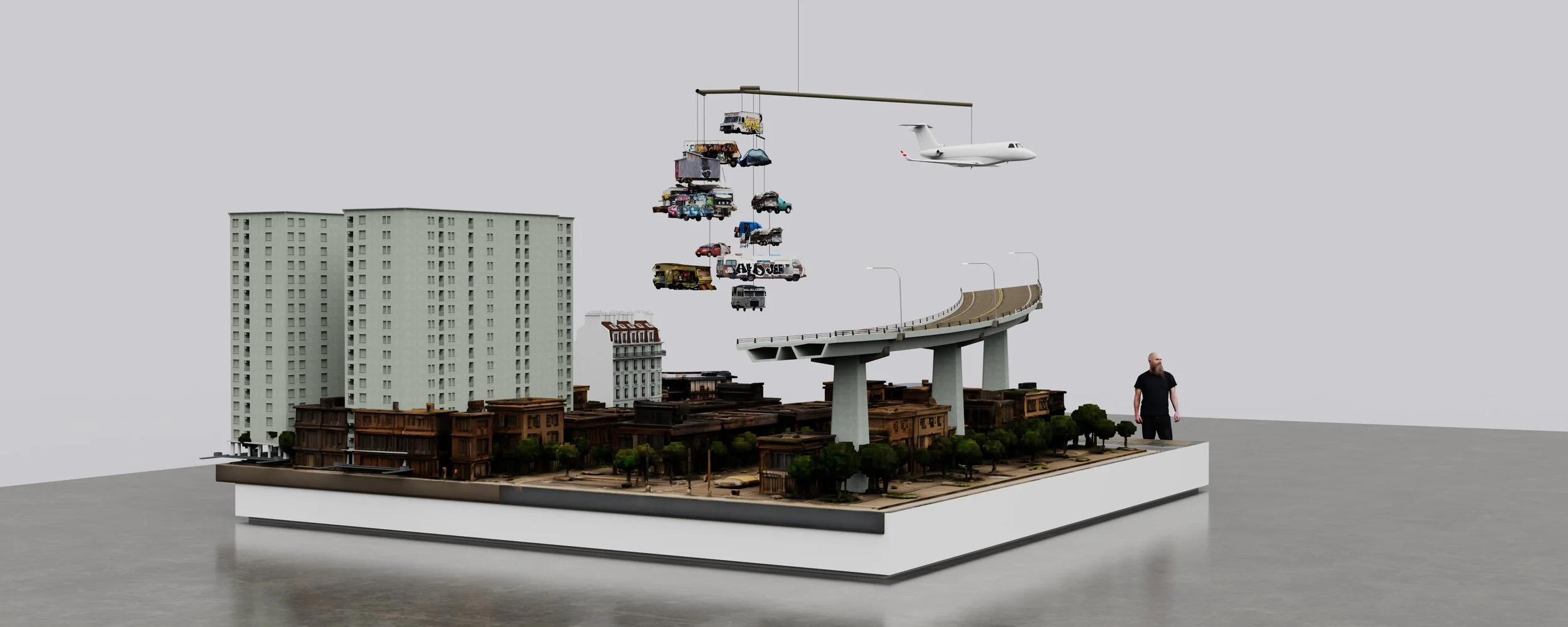
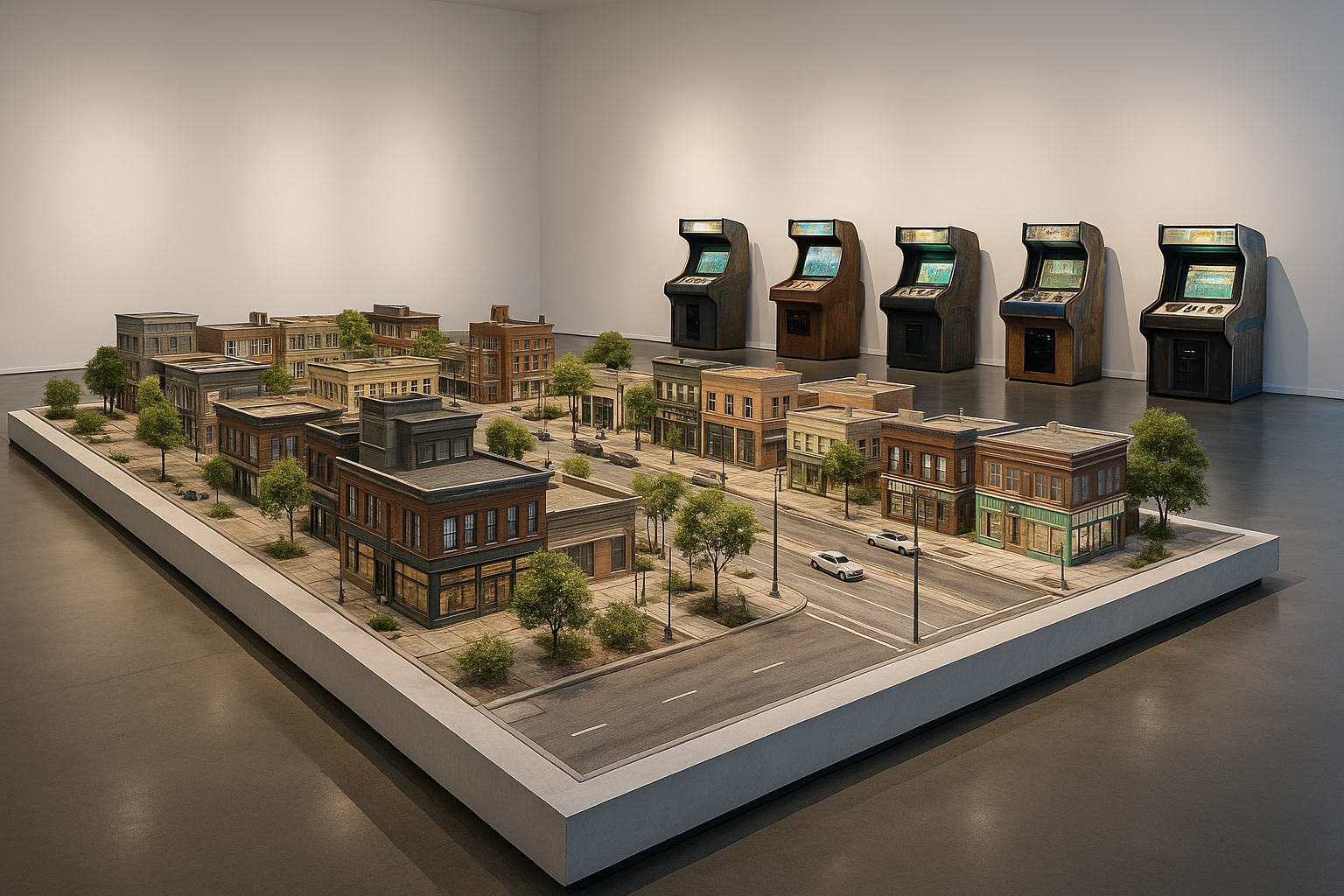
A large, highly detailed miniature city, part playground, part work site, part collapsing social ecosystem, sprawls across the gallery floor. Visitors sit at a row of arcade-style consoles, each driving a small robot that performs different kinds of everyday tasks and petty adventures inside the city. Every delivery, shortcut, party, and side quest leaves a physical mark: facades get repainted, pipes burst, streets clog, structures weaken. The game is less about spectacular violence than about how ordinary routines, quiet errors, and casual debauchery wear down a finite world over time. By the end of the run, the set carries the full scarred history of everyone who has played.
Detailed Description
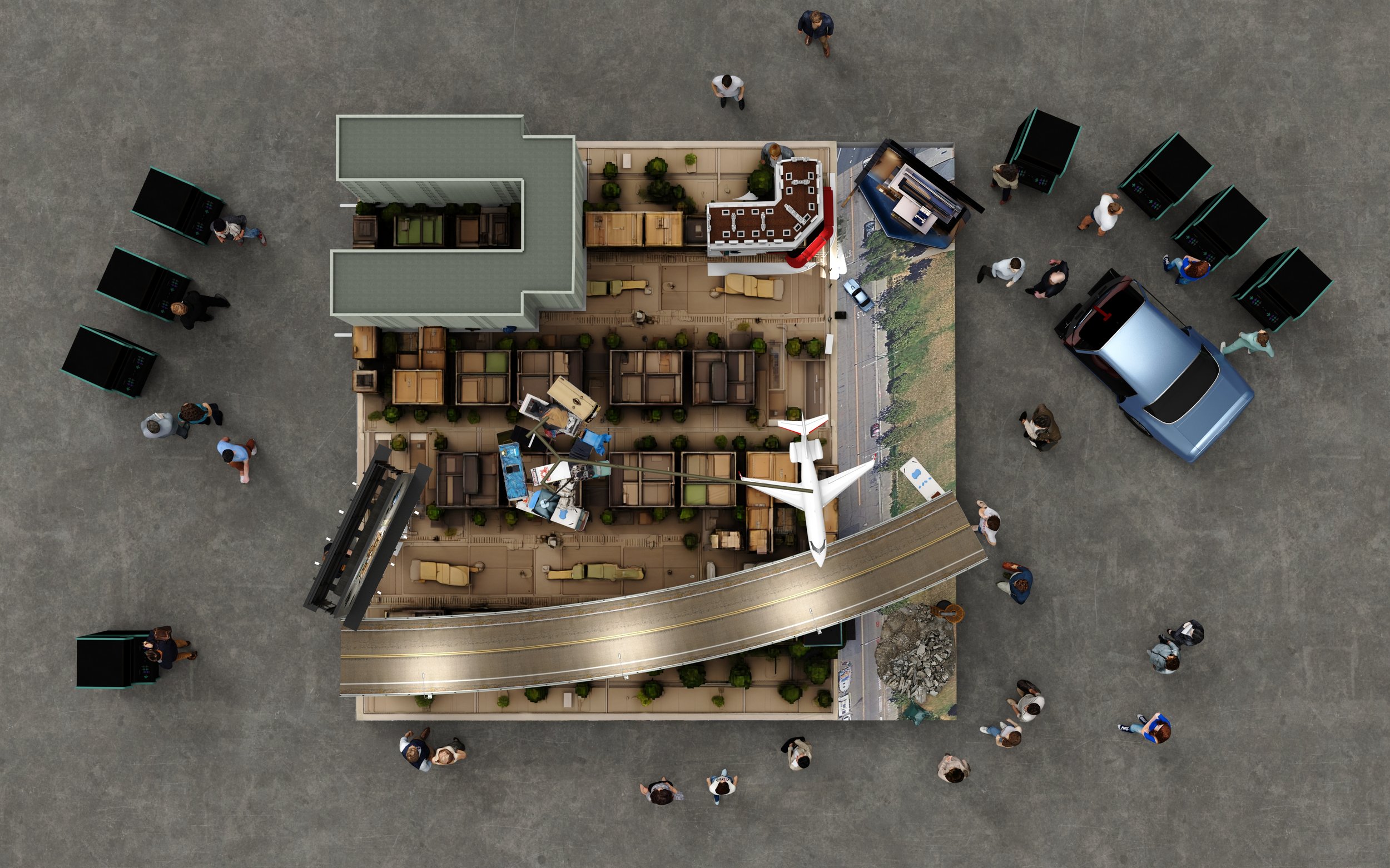
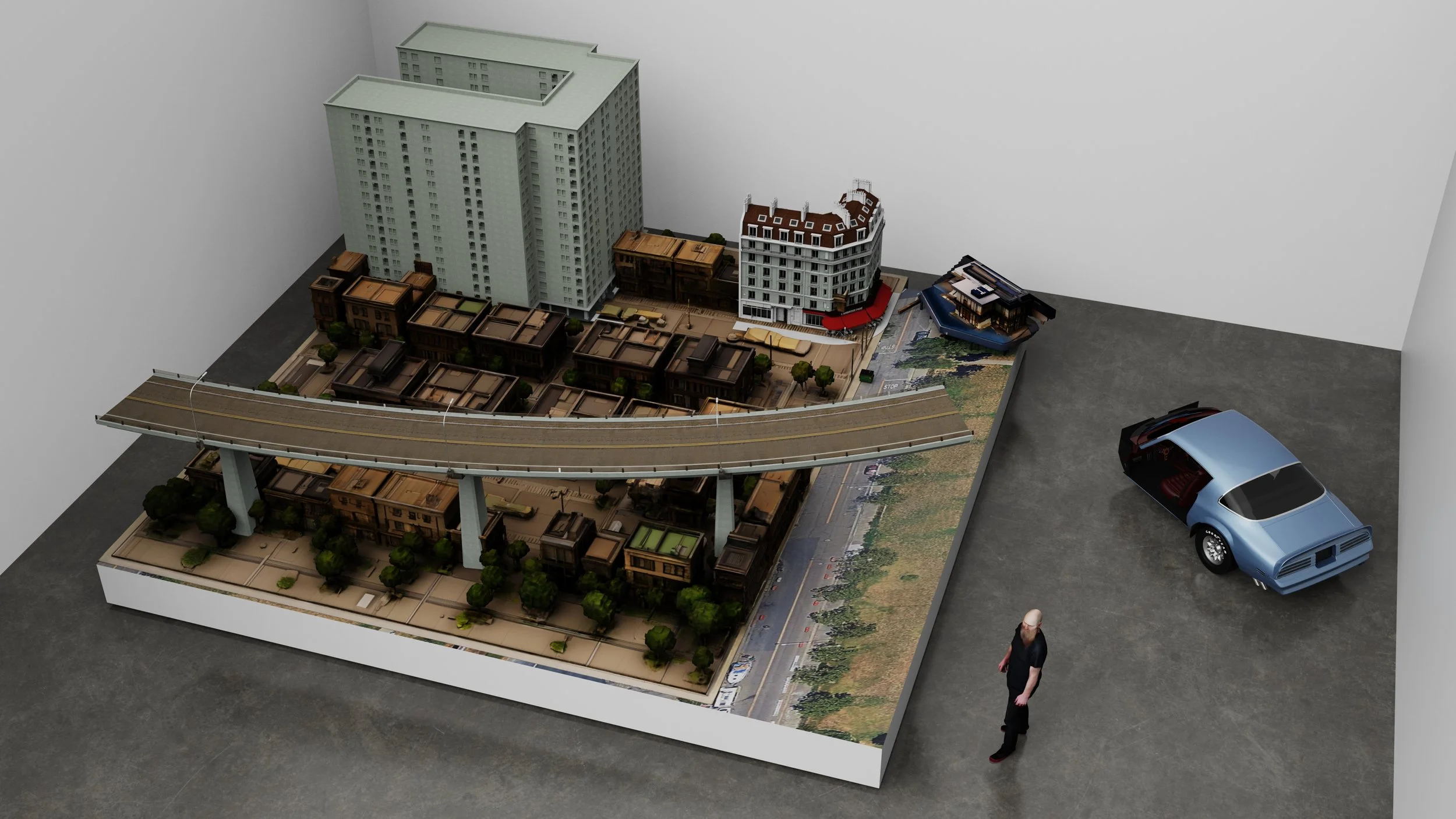
The installation centers on a sprawling miniature city built at floor level: streets, alleys, small houses, shops, work sites, parks, hidden paths, and decaying industrial zones. It is deliberately overbuilt at the start of the exhibition, full of fresh details, unscarred surfaces, and latent mechanisms that only activate under pressure.
Along one side of the gallery is a row of arcade-style game stations, with some games being somewhat realistic simulations. The drunk driving game is played in a car. The business game is on a desk, and the bathroom game is in the bathroom. Each station is linked to a different functional robot in the city: a delivery cart, a house painter, a street sweeper, a partying club-goer, a graffiti artist, a nervous office worker, a maintenance crew, a late-night driver. Players see through their robot’s camera feed and drive using simple joysticks and buttons, navigating tight streets and alleys that are otherwise inaccessible to human bodies.
Each role has its own modest goals: deliver packages on time, keep a street clean, repaint as many walls as possible, keep the party going, get home from work, and cut corners on repairs. Completing tasks earns in-game rewards and unlocks additional abilities or routes, but every action consumes or distorts something in the city. Freshly painted walls invite more tagging; shortcuts through fragile structures weaken them; street parties leave behind trash that someone else has to move; neglected maintenance eventually causes leaks, flickering signs, or collapses.
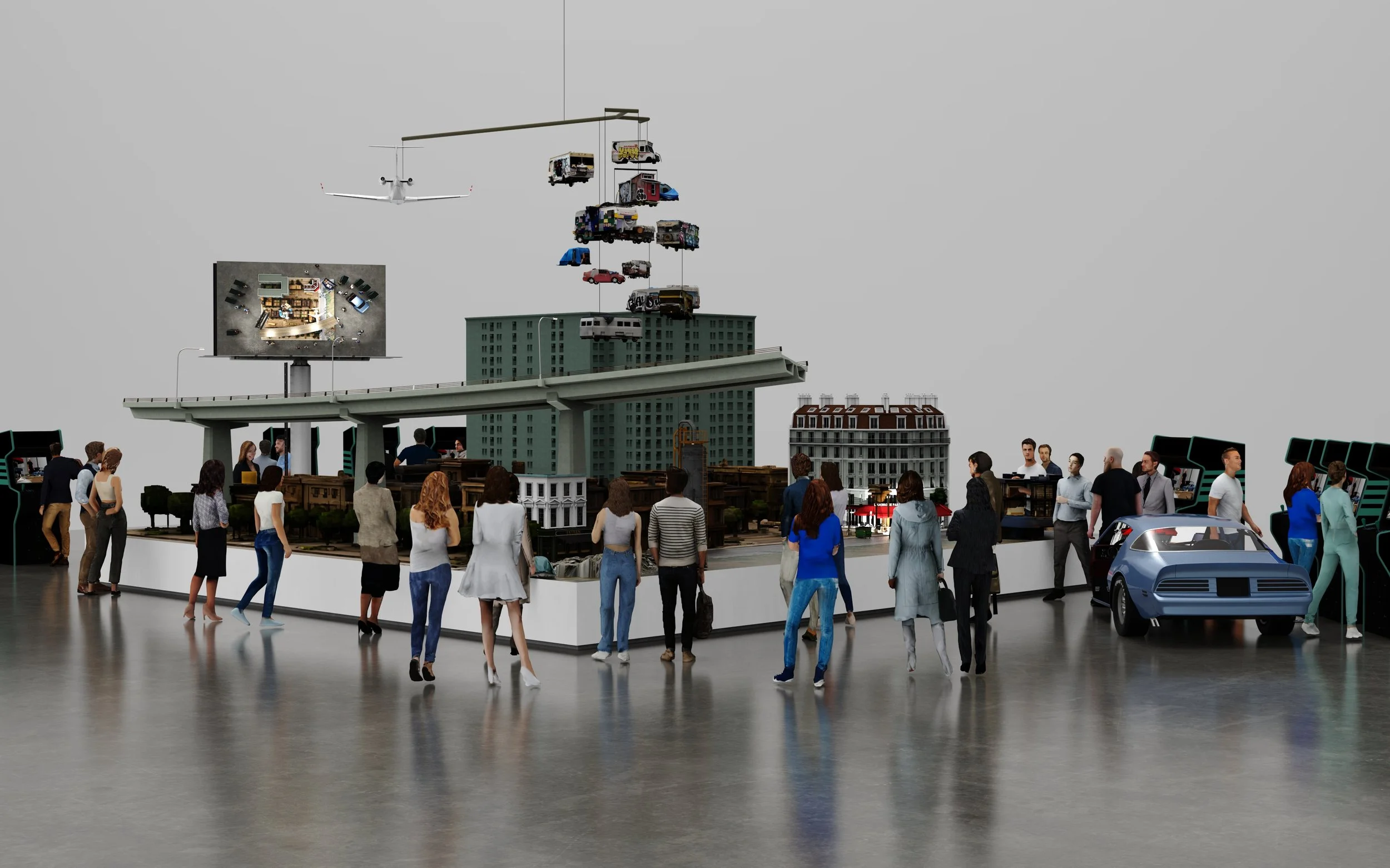
All robots share the same physical infrastructure and resources, so the aftereffects of one game are the starting conditions for the next. Small decisions accumulate into visible change: a neighborhood slowly tilts toward decay, a route becomes permanently blocked, a cluster of buildings is gradually reduced to rubble and improvised scaffolding. The city cannot be "reset" to a pristine state; it can only be patched, rerouted, or lived with in its damaged form.
Occasional "event" modes can be triggered from a central console or on a timed schedule: a storm that floods low-lying areas, a blackout that forces robots to navigate by limited light, a construction boom that opens new but fragile pathways. These events accelerate wear on certain zones while temporarily boosting others, mirroring the uneven impacts of policy, fashion, and economic cycles
Over the course of the exhibition, the miniature city evolves from a polished model into a visibly used-up world: layers of paint and signage, improvised repairs, collapsed corridors, and pockets of unexpected order. The final state is a physical archive of thousands of small plays, a record of how groups of strangers treated their shared, limited "playset Earth."
In-Game Roles (Arcade Stations)
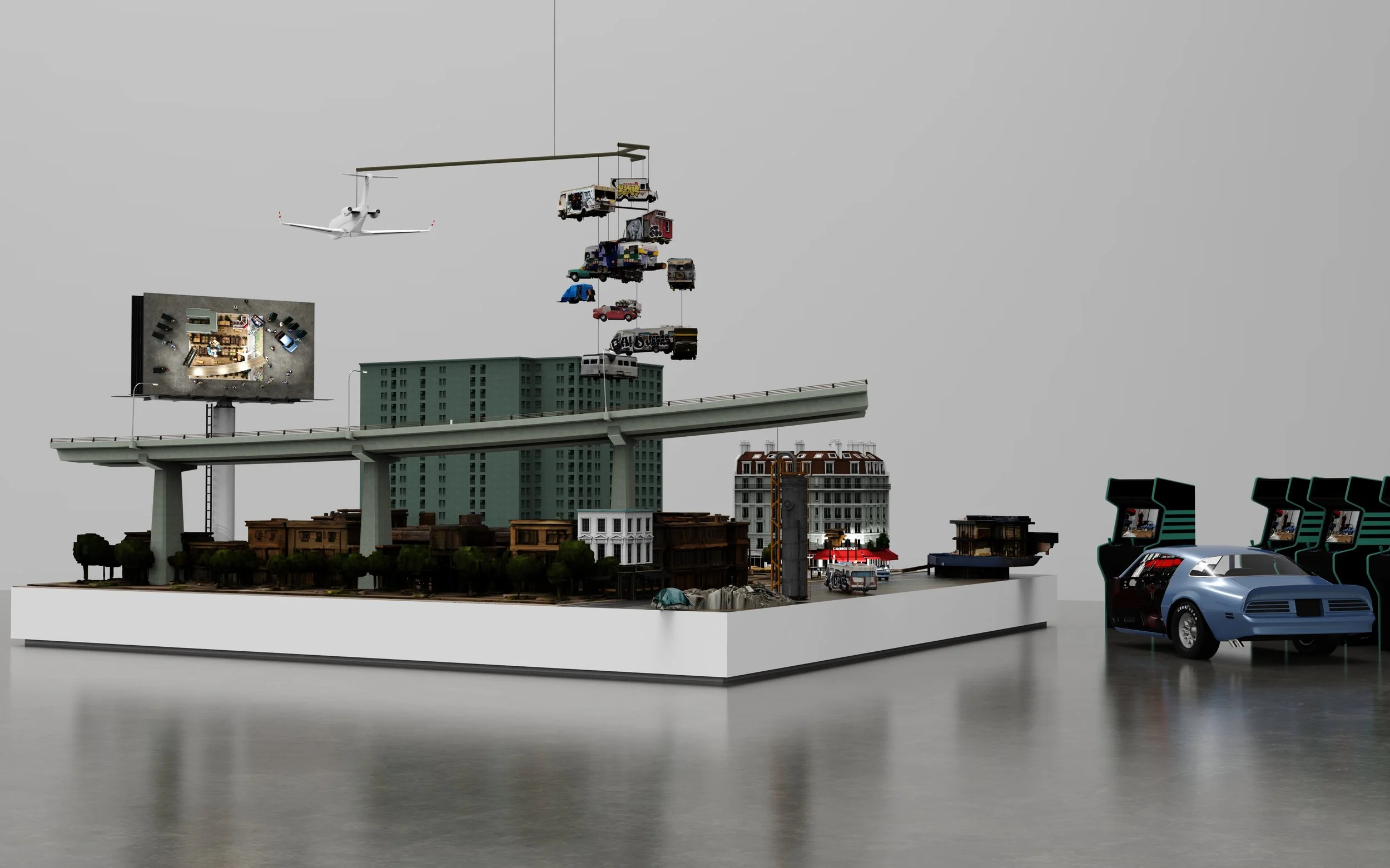
Each console is its own arcade game tied to a specific robot role in the city. Examples include:
The Graffiti Artist — A tiny robot armed with a micro-paint system. The player’s goal is to tag buildings, walls, and infrastructure. Tags physically accumulate over the course of the exhibition, slowly covering facades and signs.
The Fuzz — A police robot assigned to chase, block, and arrest the graffiti artist and other "bad actors." Its player must enforce order in a city where order is fragile, negotiated, and often subjective.
The Drug Dealer — A delivery robot that distributes small, legal, consumable intoxicants. The player navigates the city, delivering goods into other game zones and consoles while avoiding the fuzz, turning ordinary vice into a logistical puzzle.
The Drug & Drinking Game — A robot that simply enables its player-avatar to get high or drunk. The "goal" is non-goal: indulgence-as-play, where progress is measured in how thoroughly you avoid responsibility rather than how efficiently you work.
The Dog — A small, neurotic robot dog that roams the streets sniffing, pooping, peeing, marking territory, and seeking food. It reacts to damage and collapse with canine confusion and loyalty, becoming an anxious witness to the city’s decline.
The Rope-Pusher / Viagra Seeker — A hapless heroic robot locked in an absurd quest, searching for a mysterious figure named Viagra so it can have sex and "save" the world. This station parodies game tropes and masculine-coded hero narratives by making progress feel both arbitrary and strangely earnest.
The Drunk Driver — A robot car whose player drinks in real time while piloting it. As impairment increases, so does the chaos; the drunk driver inevitably breaks things, turning reckless bravado into visible infrastructural damage.
The Thief — A scavenger robot that roams the city stealing copper, gold, drugs, valuables, and any small object not bolted down. The player must physically collect items and deliver them back to a drop zone in exchange for points, literally stripping value out of the world.
The Nun — A walking conscience that roams the set advocating better behavior, attempting to redirect other robots toward modesty, repair, or restraint. The Nun rarely "wins," but leaves pockets of improbable order behind.
The Stoner — A character whose core mechanic is avoidance. The Stoner robot drifts between sites of responsibility, thinking up fun diversions and elaborate ways to avoid work; its players will work very hard to not work.
The Flight Simulator — A helicopter or drone that flies over the set, running surveillance and occasional targeted missions. The player experiences the city from above, disconnected from ground-level consequences.
The Rock and Roll Musician — A small-band robot that lives mostly in garages and basements, endlessly tweaking gear and bugging "parents" (the system) for more resources, a new amp, more power, another rehearsal space, while contributing little measurable maintenance.
The Sculptor — A robot tasked with installing drywall, patching surfaces, and building small expansions while daydreaming about a major museum show. Its player toggles between necessary labor and speculative art-making, mirroring the split focus of working artists.
The Business Person — A suit-and-briefcase avatar whose job is to move capital around the city: redirecting resources, funding projects, quietly extracting fees. The Business Person doesn’t touch the infrastructure directly but subtly changes where effort and decay accumulate.
The Scientist — A data-collecting robot that samples conditions in different neighborhoods, logging wear, pollution, rates of collapse, and the effects of other players’ behavior. It cannot fix anything itself, but its measurements influence later rule changes and event modes.
Bodily Needs — A station dedicated to the most basic, unavoidable acts: a robot that exists to find a toilet, a private corner, or a place to "take a shit." Played from the bathroom. Its path and priorities highlight how much of life and infrastructure is quietly organized around managing bodies, waste, and embarrassment.
Conceptual Frame (Play & Tensions)
Practical Effects treats gaming as an art form that has outgrown its early fixation on spectacle and violence, and is now capable of handling slower, more uncomfortable questions. Instead of centering combat, this work focuses on the grind and drift of ordinary life: commuting, cleaning, maintaining, cutting corners, partying too hard, and quietly using up what’s around you. The games within this game are not heroic quests but average lives—house painting, bookkeeping, small hustles, and minor escapes—rendered as a system that everyone shares.
Today, a large portion of the planet is playing online multiplayer games, all of them hidden away inside servers and individual consoles, each behind a narrow, first-person interface. Those games are usually only fully visible to their makers, who can zoom out, watch aggregate behaviors, and tune the rules from above. Practical Effects brings that hidden vantage into the open. Players and spectators occupy a god-like viewpoint, seeing the whole world at once and watching how hundreds of small, distributed decisions reshape a single, fragile environment.
The piece stages the tension between short-term satisfaction and long-term consequences. Each player faces small temptations to cheat, indulge, or ignore maintenance in favor of a more entertaining route, and the city absorbs those choices as permanent scars. Debauchery and dull tedium sit side by side: a wild night out for one robot is a week of extra work for another, and both unfold within the same finite set of streets, buildings, and materials.
By keeping everything physical, actual structures, real wear, and mechanical failures, the work connects the miniature city to our own resource-limited world. The playset’s roads, buildings, and props stand in for the infrastructures of Earth: easy to treat as background, hard to repair once they’re broken, and impossible to truly reset. Practical Effects invites people to enjoy the pleasure of playing with a real model city while also confronting the slow, collective destruction and chaos that play leaves behind.
Structure of Participation
Type of space: Self-directed interactive room organized around two main zones: the miniature city field at floor level and arcade games. Spectators can circulate around the perimeter and watch the live video feeds on shared monitors.
All video imagery within the games is live feed from within the game.
Rules: Basic goals and controls are explained through simple icon-based overlays and short on-screen prompts; deeper cause-and-effect (how one role’s choices impact others) is discovered through repeated play and observation. There are no win screens or final bosses; games end when time runs out or tasks are exhausted.
Guidance: Light staff presence to onboard players, assign stations, and handle robot retrieval or repairs. No performers are required; the drama comes from the interactions between players and the world.
Intervals: Designed for timed sessions with rotating groups. Each group inherits the physical state left by the previous one, so they immediately encounter the consequences of earlier plays and add their own layer of history before the next group arrives.
Social Dynamics
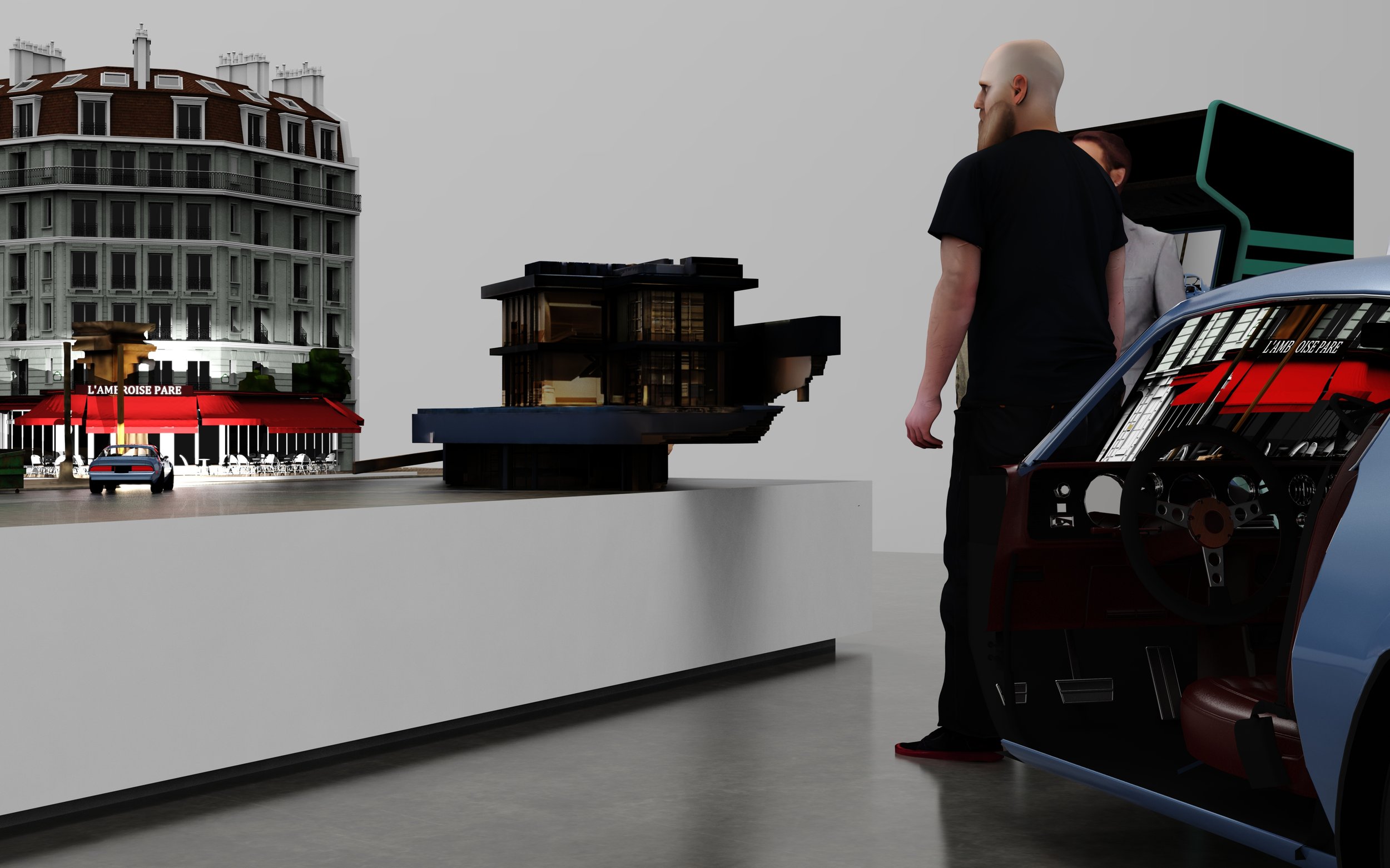
The installation encourages overlapping forms of interaction. At the consoles, players negotiate who takes which role, maintenance, delivery, partying, cutting corners, and quickly realize that their actions shape or obstruct each other’s routes. Some will try to "optimize" the city, others will push it toward chaos, and many will fall somewhere in between, treating the game as a mix of chore and escape. Around them, spectators comment, backseat-drive, and form their own narratives about what kind of city they’re collectively building or destroying.
Attention stays on the shared field: the miniature city underfoot and the live feeds overhead. The "container" is legible at a glance, robots in a model city, people at consoles controlling them, and the stakes emerge from watching cause and effect accumulate: a shortcut taken here leads to a collapse there, a party in one district becomes someone else’s cleanup job. Social dynamics range from collaboration to mischief to quiet reflection on how familiar this all feels.
Requirements & Support
Run time: Built for a continuous 4+ month run, with robust miniature structures, modular replaceable components, and scheduled maintenance cycles for robots and city infrastructure.
Space: Scalable 1000–3000 sq ft allocation, allowing for a central city field, a console row, and circulation space for spectators.
Staff & expertise: Miniature/set fabricator, mechanical/robotics engineer, and software developer for initial build; daily operation by trained gallery technicians who can manage charging, simple repairs, module swaps, and periodic re-leveling of damaged zones.
Saleable elements: Individual city blocks, heavily worked-over building clusters, or robot units can be editioned as sculptural objects at the end of the run. Documentation prints, before/after city maps or time-lapse stills showing the accumulation of damage, can be produced as limited editions tied to the installation. Video of the user's play can be created, as can video of them playing, and both can be sold via the web or in print.