Maybe You Should See Someone
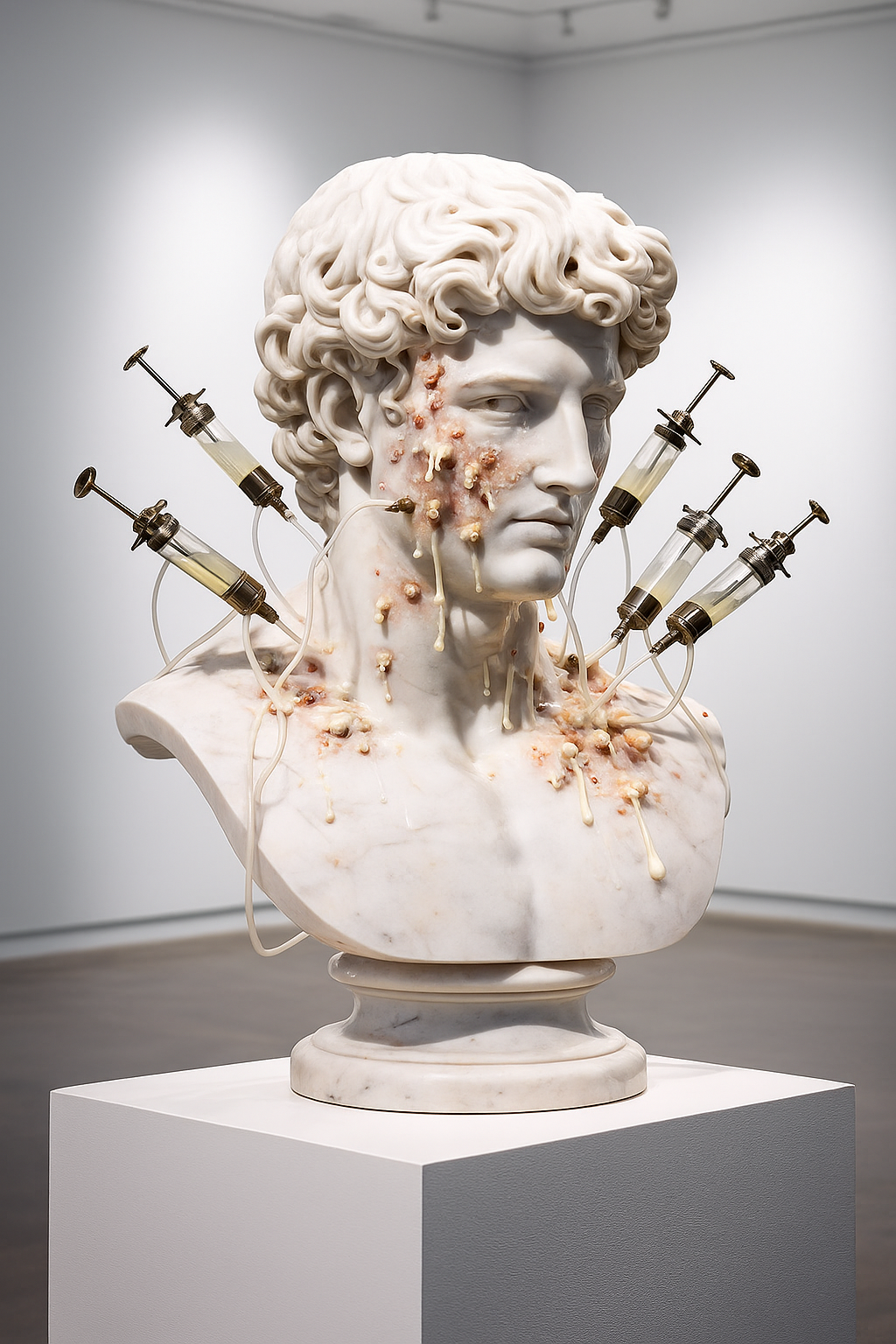
A life-size marble bust sits alone on a pedestal, carved with classical precision. At first glance, it resembles a traditional portrait sculpture, serene, idealized, timeless. But protruding from the stone surface is a network of small metal-glass syringes, each connected by soft silicone tubes that disappear beneath the marble skin.
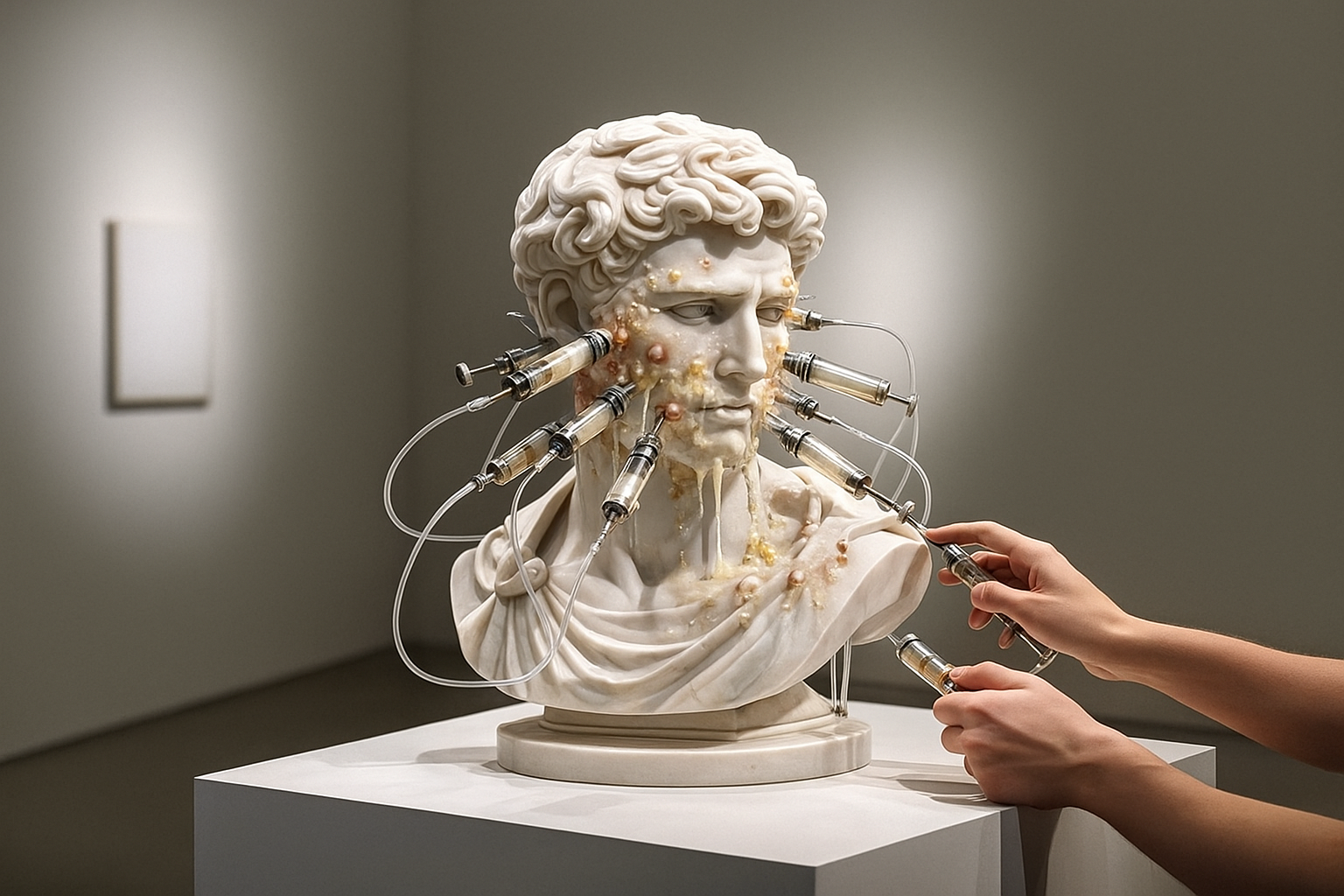
Visitors are invited to touch the syringes. When pushed, the sculpture reacts: jets of viscous, yellow-brown fluid erupt from carefully disguised apertures. Some syringes inflate cysts until they burst; others produce slow weeping drips, thick strands, or sudden sprays. Each mechanism is slightly different, creating a choreography of blemishes that forms and collapses in real time. The act of “treating” the sculpture becomes an act of infecting it.
The work shifts a sacred artifact, the marble bust, into a hyper-bodily object, collapsing the distance between admiration and revulsion, beauty and contamination, care and harm. As time goes by, the bust becomes the core of a sculpture that is a record of the viewers desires.
Detailed Description
At the center of the gallery, on a clean plinth, stands a life-sized marble bust rendered in a classical style: calm expression, balanced proportions, polished surface. The sculpture initially reads as a traditional art object, something to be admired but not touched. As visitors approach, they notice the interruptions: small syringe-like devices emerging from cheeks, neck, temples, scalp, and shoulders, their glass barrels partially filled with thick, yellow-brown or colorful fluids. Thin silicone tubes disappear back into precisely drilled channels in the marble, making it clear that the stone has been hollowed and plumbed.
Each syringe is mechanically and pneumatically linked to a microvalve and a small internal bladder or cavity hidden beneath the surface of the bust. When a visitor presses a plunger, one of several things can happen:
A subdermal cyst inflates until it becomes visibly taut, then slowly deflates or ruptures with a controlled, oozing release.
A fine fissure in the marble "weeps" a slow, thick drip that stains and discolors the surface over time.
A small hidden nozzle produces a sudden spray, spattering nearby areas of the bust with new streaks and stains.
In some cases, one syringe counteracts the effects of another, partially flushing or diluting previous marks so that "treatment" and "damage" blur together.
Over the course of the exhibition, the bust’s surface becomes increasingly marked: crusted drips, stained channels, residues of previous interactions. Gallery staff can periodically clean or partially reset the piece, but never fully return it to its original pristine state. The bust exists in a perpetual in-between: not entirely ruined, not entirely restored.
Conceptual Frame (Play & Tensions)
Maybe You Should See Someone begins with a familiar object of cultural authority: the marble bust as the museum’s idea of beauty, permanence, and importance. Art often starts as research into what beauty might be, but once that research enters the museum, it hardens into canon. This sculpture treats that canon not as a conclusion but as a starting point, one that the audience is asked, almost dared, to touch, medicate, contaminate, and revise.
The syringes parody both cosmetic intervention and medical care. Each push of a plunger feels like a treatment, an attempt to fix or improve the surface, yet it also injects new problems: cysts, stains, eruptions. The work collapses the distance between admiration and revulsion, beauty and contamination, care and harm. You are not simply looking at a face; you are actively deciding what kinds of damage or decoration seem acceptable on it.
The piece also points at how cultural standards of beauty are always in flux. What was once shocking becomes fashionable; what was once canonical becomes dull; what is marketed as "natural" is often heavily engineered. By inviting viewers to add blemishes, stains, and even absurd touches like blue gum to an otherwise timeless form, the sculpture asks whether it becomes more compelling, more relatable, or more grotesque. It stages beauty as a live negotiation rather than a fixed ideal.
Play here is tongue-in-cheek but not trivial. Pushing a syringe is a small, almost cartoonish gesture, yet it carries the weight of larger systems: cosmetic surgery, self-optimization, art restoration, and the constant adjustment of our own faces in mirrors and on screens. The title, Maybe You Should See Someone, points to the pressure to seek correction, therapy, or improvement, and quietly asks whether the "someone" doing the adjusting is really acting in our interest.
Structure of Participation
Type of space: Open, self-directed installation centered on a single pedestal-mounted bust, with clear circulation space around it and protective distance where needed.
Rules: Visitors are not instructed how many syringes to use or in what order; the system is intentionally open-ended.
Guidance: Gallery staff monitor for safety and to prevent excessive physical force, but they do not act as performers. Occasional, scheduled maintenance sessions allow staff to clear clogging, manage hygiene, and partially reset the visible surface.
Intervals: The piece runs continuously over the exhibition period. There is no fixed session length; each visitor decides how long to stay, how many syringes to activate, and whether to watch others instead of touching the sculpture themselves.
Social Dynamics
The work invites both curiosity and hesitation. Some visitors will eagerly press multiple syringes just to see what happens, treating the bust as a kind of bodily fountain or special-effects prop. Others will hover, reluctant to "damage" a beautiful classical head but drawn in by the existing marks and by seeing others act more boldly.
Because the sculpture sits in an open area, people also become aware that their choices are being watched. Pressing a plunger feels different when others are looking on, turning each interaction into a small performance of judgment: Am I beautifying this? Defacing it? Making it funnier? More honest? The visible accumulation of fluids and additions creates a rolling record of collective taste and discomfort.
Conversations around the piece are likely to drift from jokes about pimples and grossness to more serious talk about cosmetic procedures, aging, and what kinds of bodies get treated as museum-worthy. The work’s humor keeps the atmosphere from becoming too solemn while still making it difficult to ignore the underlying questions about control, shame, and beauty.
Requirements & Support
Run time: Designed for a continuous 4+ month run, with robust internal plumbing, replaceable fluid reservoirs, and regular maintenance protocols for cleanliness and mechanical reliability.
Space: A modest footprint (approx. 150–300 sq ft) within the larger 1000–3000 sq ft allocation, including circulation space and discreet access for maintenance.
Staff & expertise: Sculptor/fabricator for the marble bust and integration of tubing; mechanical and fluids engineer for pumps, valves, and safety systems; conservator input on managing residue and long-term surface changes. Daily checks by gallery technicians to refill fluids, clear clogs, and wipe surrounding floor surfaces as needed.
Saleable elements: The bust can be treated as a unique, evolving sculptural work for acquisition, either in its final, fully marked state or after a partial "restoration." High-resolution photographs documenting different phases of its transformation can be editioned as prints. Small, non-functional maquettes of the bust with syringes can also be produced as multiples. A time-lapse of the interactions will be created and can be sold.