Exploding Room
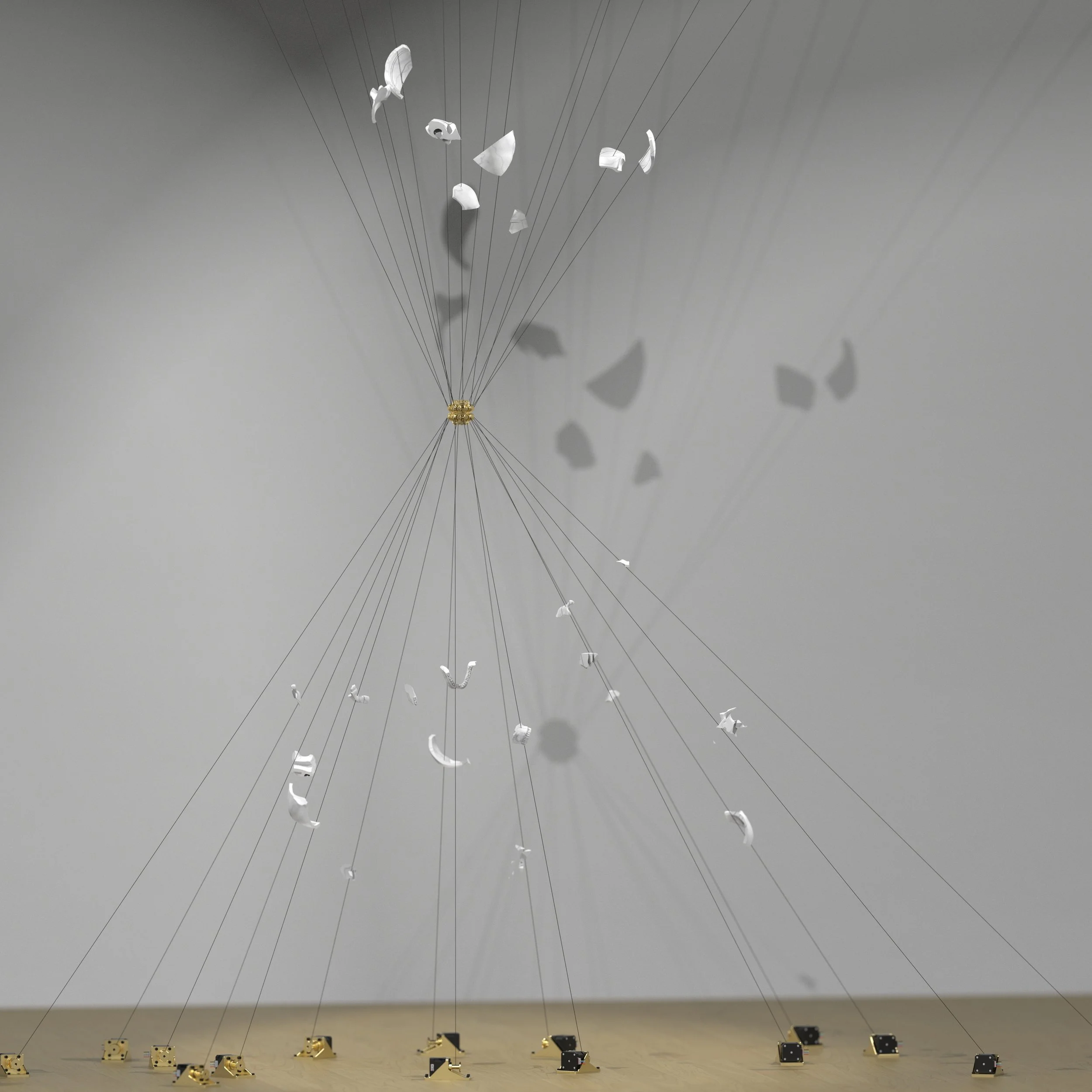
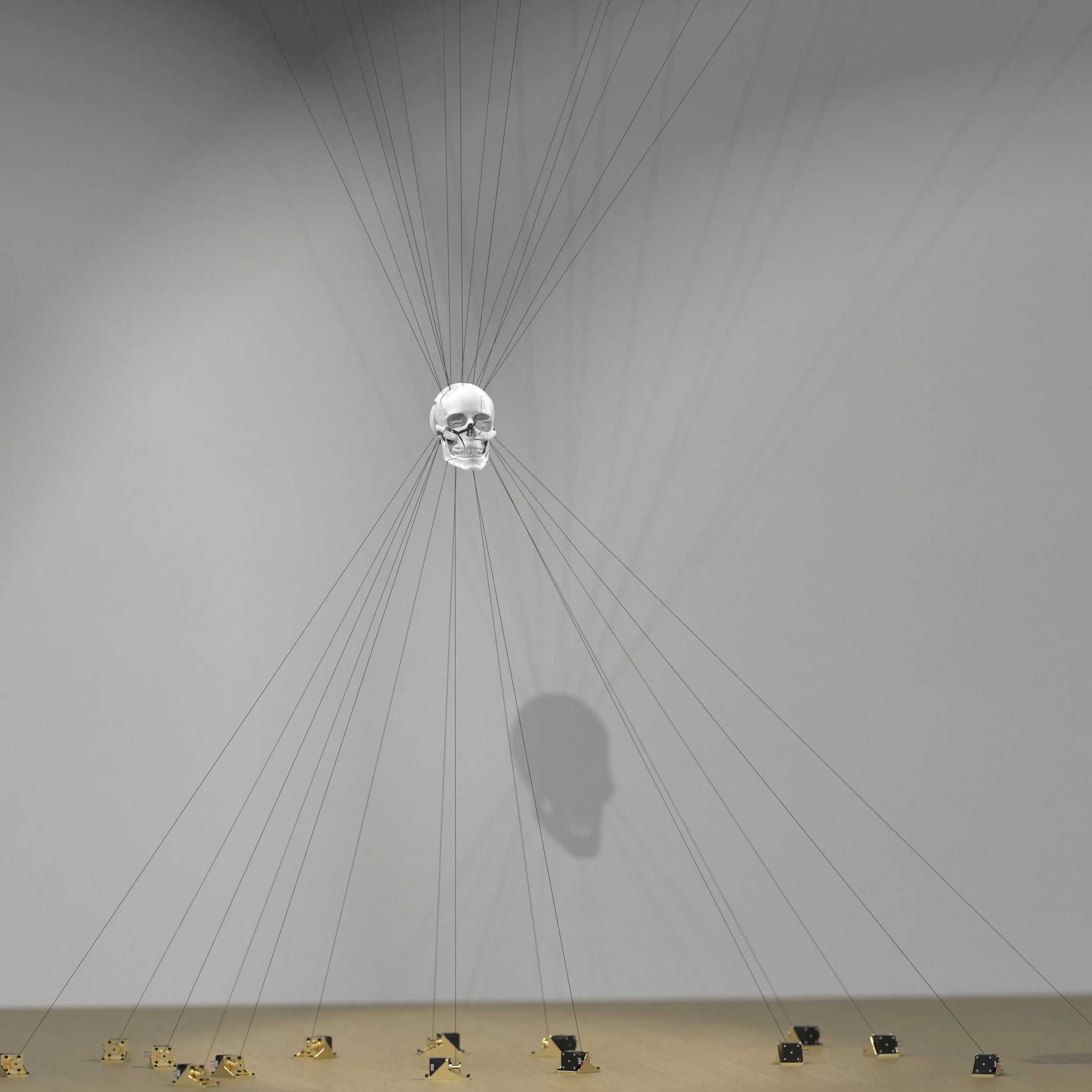
When visitors enter the gallery, they find a room frozen in mid-explosion. Fragments of objects hang in mid-air, held between the floor and ceiling by thin cables, but it’s not immediately clear what any of them are. Only when the people inside become still do motors slowly pull the pieces together, revealing a skull, a child’s toy, a chair, a table setting, an ordinary room emerging out of chaos. Any sudden movement causes that hard-won clarity to shatter: the objects burst apart again into a suspended cloud of parts. The piece is a game of stillness that turns seeing an object clearly and honestly into something that requires effort, patience, and collective discipline.
Detailed Description
Exploding Room is installed as a full-scale environment within the gallery. The architecture is minimal, a clean, neutral room, but the furnishings are initially unreadable: tangled constellations of white and metallic fragments, suspended between an overhead hub and anchored winches on the floor. Only as the system begins to assemble them does it become clear that they belong to a dining table and dishes, a chair, a small side table with a lamp, a toy on the floor, and a highly detailed skull.
At the start of each session, every object is held in an "exploded" configuration. Plates and cups hang as arcs of shards, the skull opens into petals of bone, furniture separates into planes and struts. The exploded forms remain readable enough that viewers can guess what each object is, but only as a guess; partial, provisional, never quite certain.
Motion sensors and depth cameras read the movement of bodies in the room. When the system detects that overall motion has dropped below a threshold, that people are truly standing still, it slowly begins to pull the fragments of one object back into alignment. Over the course of many seconds, a skull assembles from orbiting pieces, a cup closes, a chair comes back together. If the group maintains their stillness, more objects complete themselves, giving visitors a brief experience of the room as a coherent, intact world.
Any decisive movement, someone moving position, walking, gesturing too broadly, trips the system back into its exploded state. The same motors that assembled the objects now reverse, pulling everything back into a suspended cloud. The room never punishes movement in a conventional way; instead, it quietly withholds clarity. Visitors learn that to really see a thing, to see its shape, its weight, its presence, they have to work for it, not by doing more, but by doing less and paying attention.
From a viewing zone outside or above the room, spectators can watch groups attempting this collective stillness. Some groups achieve a brief, crystalline moment where the objects are whole; others never quite manage it, living only with fragments and outlines.
Conceptual Frame (Play & Tensions)
Exploding Room is a contemplation on the work it takes to see an object clearly and honestly. It uses the simple, almost childlike game of freezing in place to ask what kind of attention is required for the world to cohere. In a culture of constant motion, scrolling, swiping, glancing, it proposes that clarity is not a given property of things but a negotiated state that depends on our attention to them.
The piece inverts the usual logic of destruction games. Here, the explosion is the default condition: fragmentation is easy, automatic, and visually seductive. Wholeness is fragile and hard-won, only achieved when a group chooses to restrain itself. The skull, toy, and furniture read as a cross-section of domestic life and mortality, suggesting that even the most intimate or final images we hold of ourselves are assembled from many unstable pieces.
As a form of play, Exploding Room borrows the rules of playground games like "Red Light, Green Light" but shifts the stakes from getting caught to seeing clearly. The score is not kept by numbers but by how fully and for how long the room can cohere around you. The work stages a tension between individual impulse and collective intention: one person’s fidget can undo everyone else’s effort, and yet the only way to experience the room in its intact state is together.

Structure of Participation
Type of space: Self-directed interactive room that visitors physically enter, paired with a viewing zone for onlookers.
Rules: A brief cue at the entrance hints at the core mechanic ("When the room is still, the objects will come together"), but most understanding comes from trial and error. There are no explicit scores or timers; the feedback is purely visual and spatial.
Guidance: Light staff presence at the entrance to manage group size, explain basic safety (no touching suspended fragments, no running), and occasionally reset the system if needed. No performers are required.
Intervals: Designed for timed groups entering at regular intervals.
Social Dynamics
Inside the room, visitors quickly realize that their own small movements affect everyone’s ability to see the objects assemble. Some people become advocates for stillness, quietly coaching others to "hold it" so the skull can finish re-forming; others play the spoiler, testing how little motion is needed to trigger a collapse. The social negotiation between restraint and disruption becomes part of the piece: a live demonstration of how fragile shared attention can be.
Outside the room, spectators watch groups attempt this collective task, reading their body language and rooting for or against their success. The only "interface" is the behavior of the objects themselves and the posture of the people inside. The container is simple and immediately legible, a room where fragments hang until you learn how to make them whole, yet the dynamics of trust, patience, and sabotage keep it replayable.
Requirements & Support
Run time: Engineered for a continuous 4+ month run, with robust cable systems, motion detection, and scheduled maintenance for alignment checks and component replacement.
Space: Ideally a dedicated room within the 1000–3000 sq ft allocation (approx. 600–1200 sq ft for the explodable room plus circulation and viewing space).
Staff & expertise: Structural/mechanical engineer for the exploded objects and cable structures; controls engineer for motion sensing and coordinated actuation; daily operation by trained gallery technicians who can monitor sensors, run diagnostics, and perform basic repairs or recalibrations.
Phones: No phones are needed; the experience is entirely physical and visual, with an optional overhead display that occasionally shows silhouettes of previous successful assemblies as a ghosted reference.
Saleable elements: Individual exploded objects can be editioned as sculptures. Documentation prints or slow-shutter photographs of the room transitioning between fragmentation and wholeness can be produced as limited editions tied to the installation.