Adoration
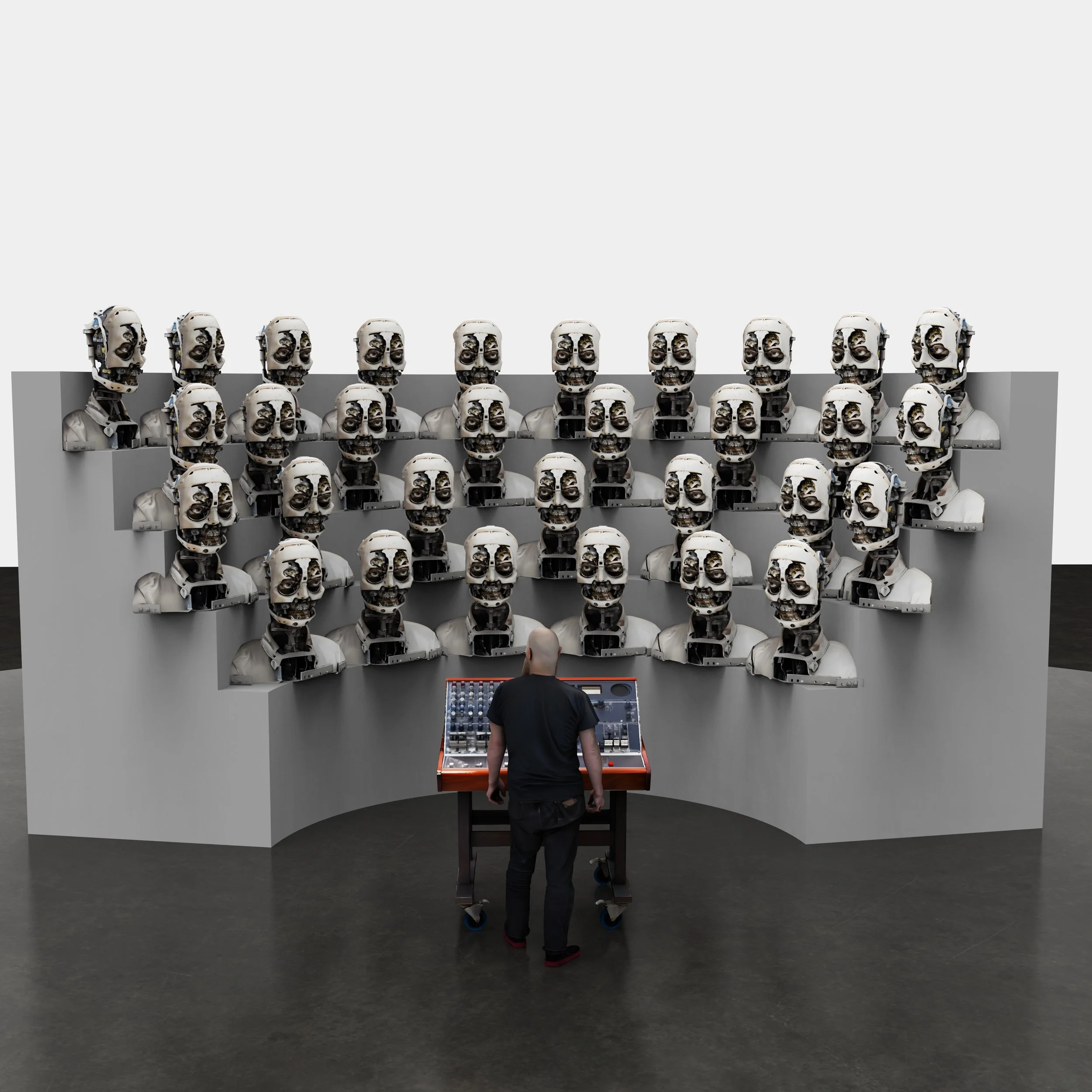
A pedestal sits in the center of the gallery, facing a dense miniature audience of mechanical spectators in tiered stands. When a visitor steps onto the stage, unlabeled knobs and buttons within arm’s reach trigger waves of applause, boos, nervous silence, scattered coughs, and algorithmic "engagement" noises. At first, the crowd responds generously, but the longer someone chases its approval, the more fickle, demanding, and difficult to please it becomes. Performers can try to game the system, but the system is also quietly gaming them, tracking patterns, shifting baselines, withholding clear feedback. The piece turns the pursuit of attention into a literal game that is loud, funny, and slightly humiliating.
Detailed Description
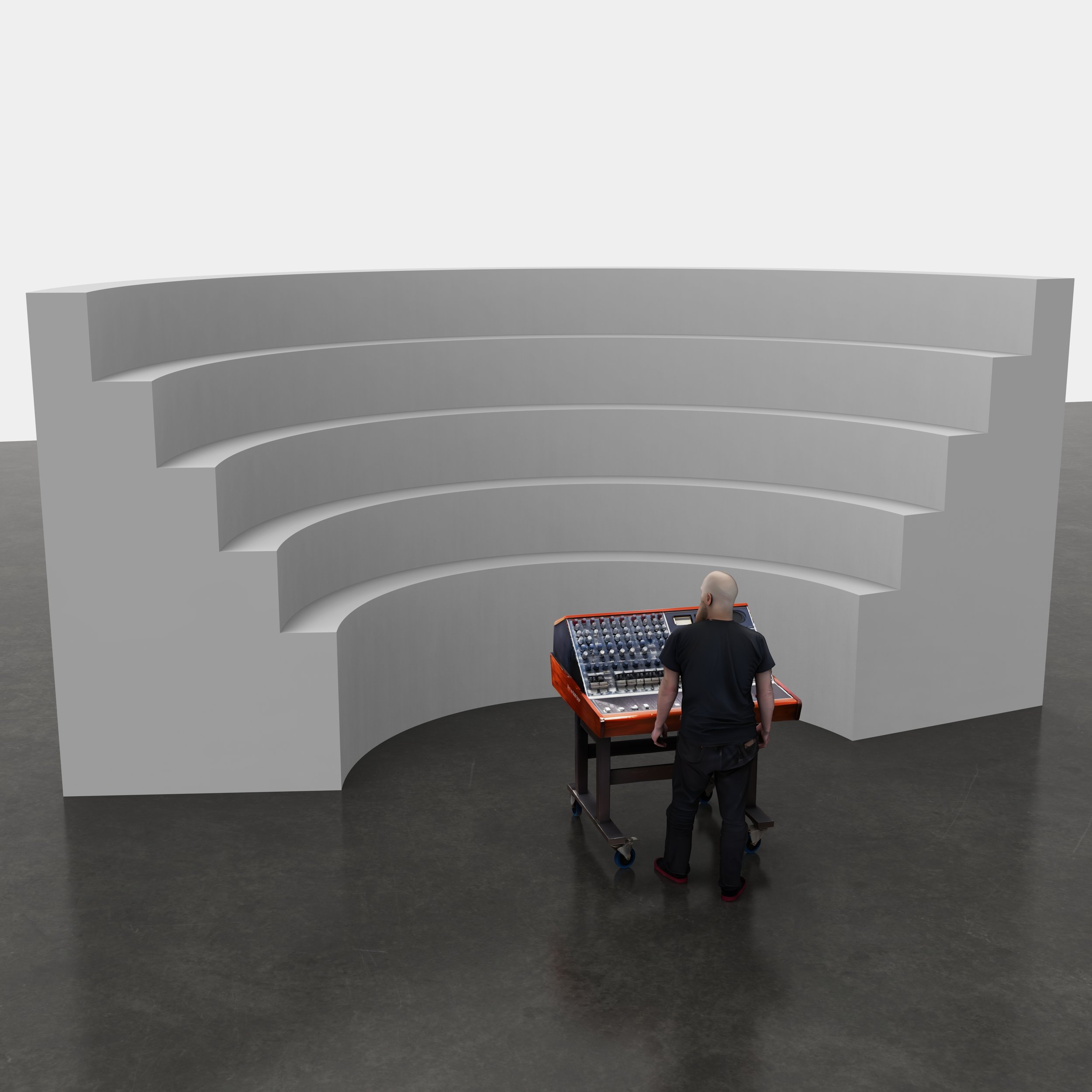
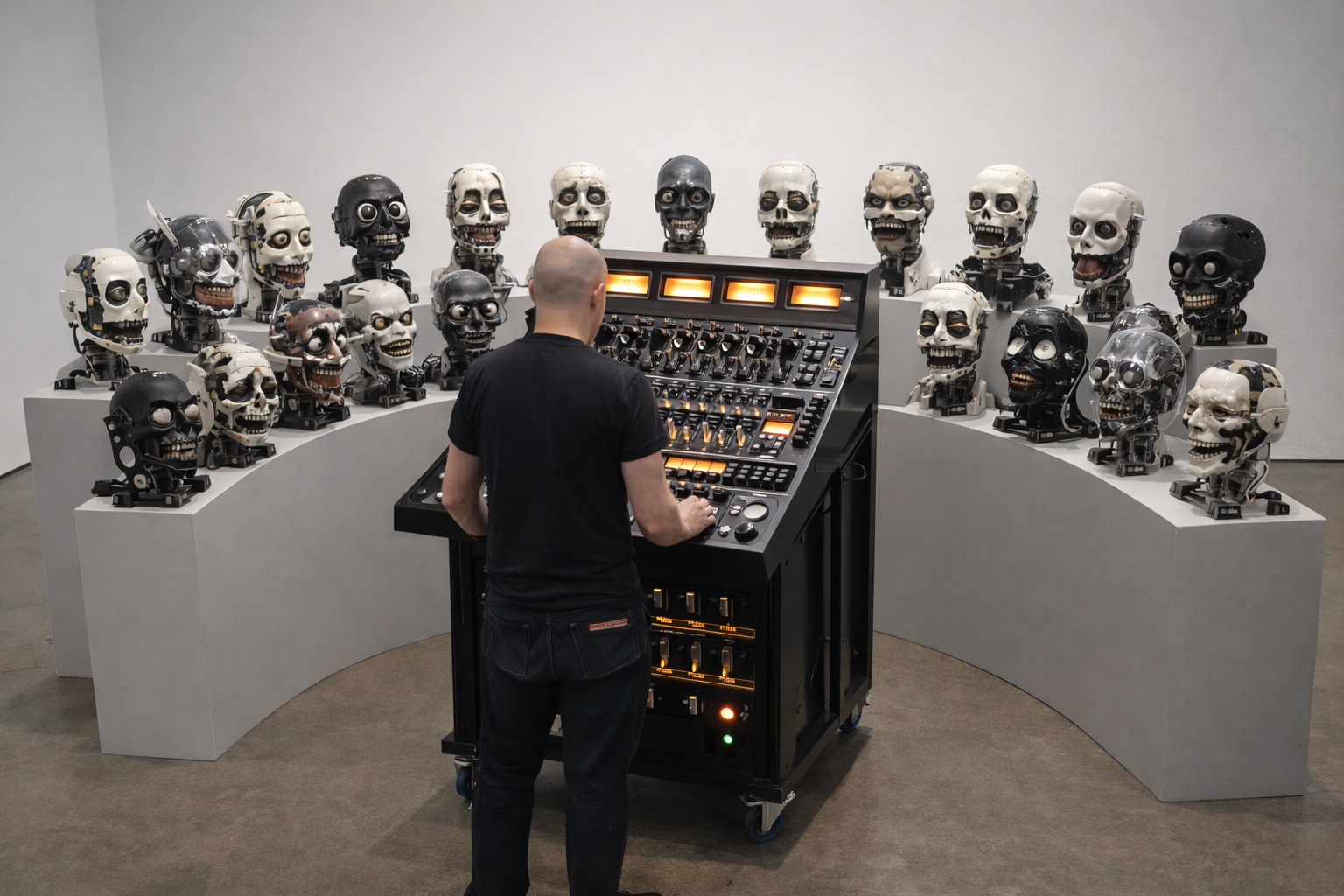
Adoration is organized around a compact performance zone: a low stage or pedestal large enough for one or two people to stand on comfortably. Facing this stage, built into a curved riser or wall, is a dense "audience engine" composed of small mechanical elements: nodding heads and a distributed array of speakers. The overall effect is of a toy-sized crowd facing the performer.
When no one is on the stage, the audience idles in a low-energy state: occasional rustles, soft light flickers, a cough or two. Floor markings and subtle lighting invite visitors to step up. Once someone enters the performance zone, the system recognizes their presence with a slight swell of attention, lights brighten, heads turn toward the stage, and a murmur passes through the crowd.
On the front edge of the pedestal is a small console of unlabeled controls: knobs, sliders, and buttons, each mapped to different crowd behaviors. One might trigger a surge of applause; another might call up scattered boos, slow clapping, or indifferent phone-scroll gestures in the miniature audience. Some controls alter the "mood" of the crowd globally—making it more generous, more hostile, or simply unreachable for a period of time.
Underneath this direct mapping is a second layer of logic that tracks how each performer uses the controls and how long they stay on stage. Early interactions tend to be rewarded: applause comes easily, lights flash, and approval is loud and satisfying. As the session continues, the same actions yield weaker responses. The system begins to require more complex combinations, longer pauses, or unexpected gestures in order to respond positively. Over time, it can also develop a kind of "fatigue," offering only lukewarm reactions no matter what the person does.
There may or may not be avenues to reattain past glory.
In addition to crowd noise, the system can expose a rhythmic layer. Applause, boos, coughs, gasps, and light sweeps are quantized to an internal clock, so that repeated control patterns produce loops and grooves rather than pure chaos. A visitor willing to listen closely and experiment can begin to "play" the audience like an instrument, building call-and-response phrases, drops, and builds in the soundscape and light. The installation doesn’t advertise itself as a musical tool, but for those inclined, Adoration doubles as a strange, slightly hostile DJ rig where the crowd itself becomes the drum machine.
Conceptual Frame (Play & Tensions)
Adoration treats the contemporary attention economy as a carnival game with shifting rules. It takes the familiar logic of social media post, get feedback, adjust, repeat, and compresses it into a physical encounter with a small but intense audience. The title points to a desire that is both intimate and industrialized: the wish to be liked, followed, adored, but only through interfaces and metrics designed by someone else.
The piece uses play to expose how quickly a simple feedback loop can become a trap. At first, pressing a button and hearing applause is pure pleasure. Soon, the performer is trying to decode what the crowd wants, repeating moves that used to work, pushing for one more burst of approval. The more they chase it, the less satisfying and more conditional it becomes. For some, the only way out is to shift perspective—to treat the system not as a judge to be appeased but as an instrument to be played, turning raw approval metrics into rhythm, call-and-response, and improvised composition. This arc mirrors how algorithmic validation often feels in everyday life: easy dopamine up front, then an escalating schedule of effort and diminishing returns.
By making the crowd mechanical and clearly artificial, the installation avoids pretending that this is a "real" audience in any emotional sense. Yet because people are standing on a literal stage in front of others, the feelings it provokes, embarrassment, elation, and frustration, are very real. The work sits in the tension between knowing that the system is fake and feeling compelled by it anyway.
Adoration also plays with the ambiguity of agency. Who is in control: the person at the console, or the logic that decides which inputs will still work? The performer appears to be commanding the crowd but is constantly being scored, trained, and subtly routed by unseen algorithms. In this sense, the piece echoes the asymmetry of online platforms, where users perform inside containers they didn’t design, hoping to catch waves of visibility whose conditions are opaque.
Structure of Participation
Type of space: Self-directed installation with a central stage/pedestal and a facing mechanical audience wall, surrounded by standing room for onlookers.
Rules: Simple, be adored.
Guidance: Light staff presence to manage the queue, ensure only one or two performers are on the stage at a time, and to reset the system if needed. No performers are required; visitors generate all onstage activity.
Intervals: Sessions are short (a few minutes) and run continuously during open hours. Between sessions, the system returns to an idle state but retains some memory of aggregate behavior.
Social Dynamics
The installation creates a tight loop between performer, mechanical audience, and human onlookers. People in line watch how others use the controls and how the crowd responds, forming theories about what "works" and quietly judging both the person and the machine. Some visitors step onto the stage ready to perform, treating it like karaoke or stand-up with a robot crowd; others engage more tentatively, poking at the controls and laughing at the unexpected responses.
Because the crowd becomes harder to please over time, late performers may find themselves struggling to elicit a reaction, prompting a different kind of play: ironic failure, deliberate bombing. This shift from chasing approval to mocking or resisting it, is part of the piece. It shows how people adapt when a feedback system stops feeling fair.
A visitor can walk away after their session, but their performance lingers in the memory of the crowd logic, affecting how the next person’s attempt is received.
Requirements & Support
Run time: Designed for continuous operation over at least 4 months, with robust actuators, speaker arrays, and control electronics. Regular maintenance is needed to service moving parts, check sound levels, and update or tune behavior algorithms as required.
Space: Approximately 300–800 sq ft within the larger allocation, including stage, audience structure, and circulation space for queues and onlookers.
Staff & expertise: Mechanical/electronics engineer for audience mechanisms; sound designer for crowd voices and responses; interaction designer/software developer for behavior logic and the adoration meter. Daily operation by gallery technicians trained to monitor system health, manage visitor flow, and make minor adjustments.
Saleable elements: Sections of the miniature audience structure—rows of heads, clapping units, or standalone "adoration meters"—can be editioned as sculptural works. Each interaction can be recorded and sold.